
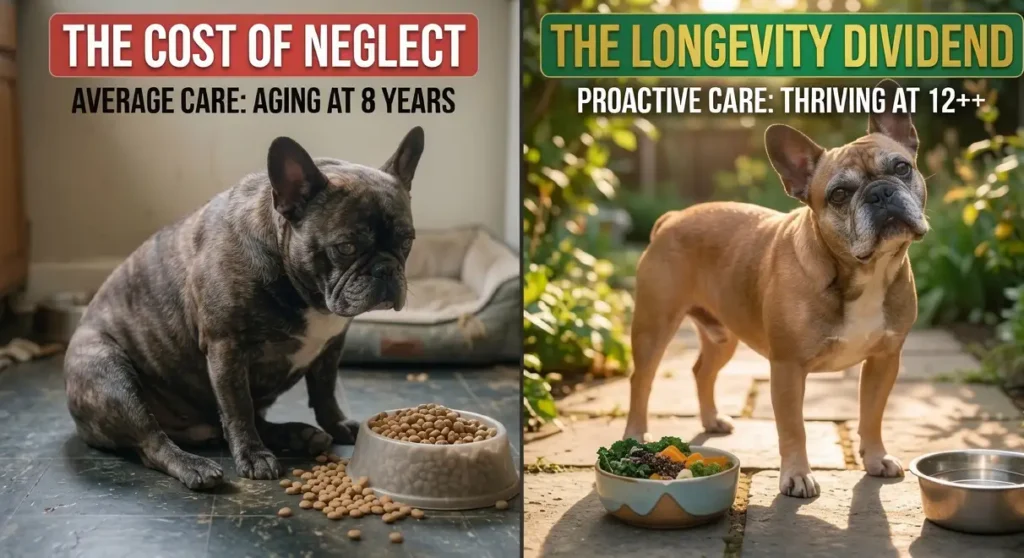
Owning a French Bulldog is a bit like being a guardian to a high-maintenance piece of fine art. They are beautiful, full of character, and undeniably fragile in ways that a Golden Retriever or a Beagle simply isn’t. As a Frenchie parent, you’ve likely looked into those big, soulful eyes and wondered: How long do I really have with you?
While the standard veterinary journals cite a lifespan of 10 to 12 years, we aren’t here to settle for the average. After spending dozens of hours analyzing clinical data and community feedback, we’ve realized that Frenchie longevity isn’t about luck; it’s about understanding the specific biological “taxes” this breed pays and learning how to provide a refund.
- The Oxygen Debt Understanding the Aerodynamic Tax & BOAS.
- The Inflammation Clock Anti-inflammatory diet & gut health secrets.
- The Compact Spine Protecting your Frenchie from IVDD.
- The Milestone Protocol Year-by-year care from puppyhood to senior.
- Commonly Asked Questions Average lifespan, color effects, and pain signs.
French Bulldog Airway Health: The “Smushed Face” Biological Tax
Most blogs tell you that Frenchies have “flat faces.” But to understand their lifespan, we have to look deeper at the Aerodynamic Tax.
Every breath a Frenchie takes requires significantly more muscular effort than a dog with a functional snout. Imagine breathing through a straw while running a marathon that is the daily reality for a brachycephalic dog. Over a decade, this constant negative pressure creates a “hidden workout” for the heart, which must work harder to keep up with the oxygen demand..

Longevity starts with “Quiet Breathing.” If your Frenchie’s snoring is audible while they are awake, they are burning through their biological clock faster. Addressing stenotic nares or elongated soft palates early in life isn’t “cosmetic surgery” it’s adding years to their heart health.
Managing Inflammation: Diet Tips for French Bulldog Longevity
Aging, in scientific terms, is often just a synonym for chronic inflammation. For French Bulldogs, this “internal fire” burns hotter than in other breeds due to their unique physiology.
Frenchies are notorious for “leaky” systems, sensitive skin, itchy paws, and digestive upset. When their immune system is constantly fighting a protein it can’t properly digest, it creates systemic heat that wears down vital organs like the kidneys and liver over time.
The Longevity Bowl: Integrating cooling, high-antioxidant whole foods is key.
Contains papain, a powerful enzyme that helps a stressed Frenchie gut break down tough proteins.
Rich in potassium and magnesium to support heart health and maintain steady energy levels.
A lean protein source that supports muscle mass without the dangerous calorie density of fatty meats.
IVDD Prevention: Protecting the Compact French Bulldog Spine
We love the “Cobby” look (the short, muscular frame). But that shape comes from a genetic condition called Chondrodystrophy (disproportionate dwarfism). Their spines are essentially a compact symphony of vertebrae that are often naturally misshapen.
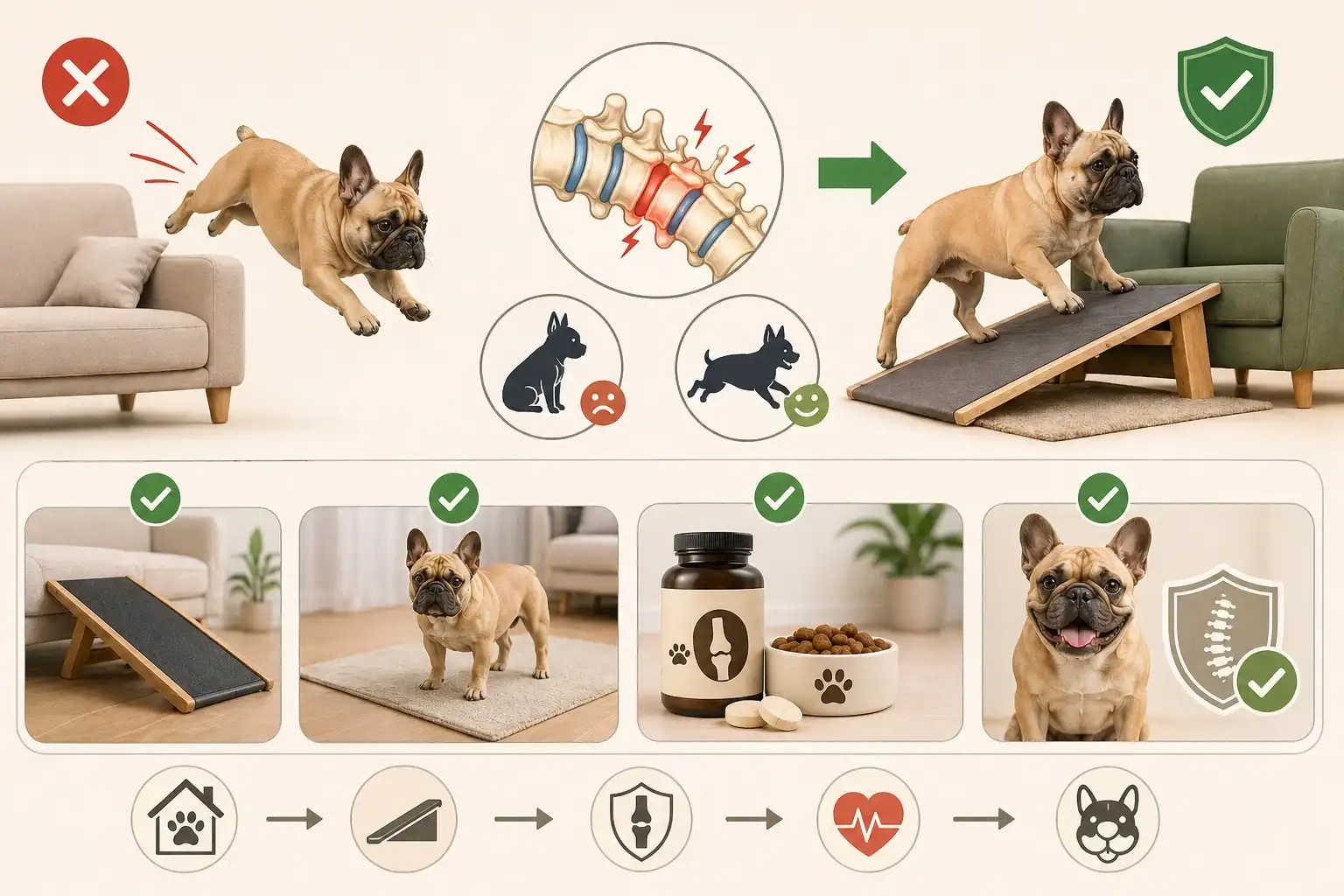
In a Frenchie’s world, a single jump off a high sofa isn’t just an “oops” moment; it’s a potential life-altering event. Intervertebral Disc Disease (IVDD) doesn’t just cause pain, it causes a loss of mobility. And for a Frenchie, mobility is life.
Treat your home like a “No-Impact Zone.” Use ramps, rugs for traction on hardwood floors, and high-quality joint supplements starting as early as age two, not age eight.
Temperature Regulation: Preventing Heat Stress in French Bulldogs
A Frenchie’s internal cooling system (panting) is notoriously inefficient. While most parents are aware of acute “heatstroke,” many overlook the cumulative impact of Acoustic and Thermal Stress.
Because of their large ears and unique skull shape, Frenchies are highly sensitive to high-frequency sounds and stagnant air. A corner of your living room that feels “fine” to you might be a pocket of warm air for a dog sitting 10 inches off the ground. Overheating doesn’t always result in an emergency; sometimes, it manifests as “micro-stress” that taxes their vital organs daily.
French Bulldog Age Chart: A Year-by-Year Life Stage Guide

The Structural Foundation
This is the era of prevention. Focus on airway assessment and weight stabilization. A Frenchie who is 2 lbs overweight at age 2 is at high risk for joint failure by age 7.
The Metabolic Pivot
The most dangerous phase. As energy levels drop, metabolism slows. Use high-fiber snacks like Bananas to keep them full without the caloric load.
The Cognitive Sunset
Keep their minds “young.” Use scent work and puzzle toys to prevent cognitive decline. A sharp mind keeps the nervous system active as mobility slows.
The “Lean” Frenchie lives 20% longer. If you can feel your Frenchie’s ribs but not see them, you are doing better than 80% of owners. Every ounce of fat on a brachycephalic dog is a physical weight on their lungs and a chemical weight on their heart.
Maximizing the French Bulldog Life Expectancy
We don’t get long enough with these “clowns in the cloak of a philosopher.” But the difference between a 9-year lifespan and a 13-year lifespan is found in the small, daily “deposits” you make into their health bank.
It’s the decision to use a ramp. It’s the choice to add a little fresh Papaya to their bowl. It’s the vigilance of keeping them cool when the sun is high. You aren’t just a dog owner — you are the guardian of a very fragile, very beautiful flame.
Commonly Asked Questions

Written by Zain
Lead Researcher @ The Breed Expert
Zain spends dozens of hours every week analyzing veterinary journals and community feedback to provide Frenchie parents with accurate, science-backed advice.
Disclaimer: The science-backed advice on The Breed Expert is for educational purposes only. Every Frenchie is unique; what works for one may not work for another due to individual allergies or underlying conditions. This content is not a substitute for professional veterinary diagnosis. Always consult your vet before making significant changes to your dog’s diet or healthcare routine.