
A full-grown French Bulldog is usually about 11–13 inches tall at the shoulder and commonly weighs around 17–28 pounds, depending on sex, genetics, muscle, structure, and body condition.
Most Frenchies reach most of their height around the first year, but their chest, muscle, and adult body shape may continue filling out after that.
Around 11–13 inches at the shoulder.
Around 17–28 pounds for many adults.
Bigger is not always better. A Frenchie should look solid, not round or overweight.
French Bulldogs may be small, but their growth journey can surprise new owners.
One month your Frenchie puppy may look tiny, round, and perfectly balanced. A few weeks later, they may suddenly look longer, slimmer, leggier, or slightly awkward. That does not always mean something is wrong. French Bulldogs often grow in stages, with height, bone, muscle, and body shape developing at different speeds.
This guide explains how big French Bulldogs usually get, when they stop growing, what a healthy weight looks like, and how to support steady growth from puppyhood to adulthood.
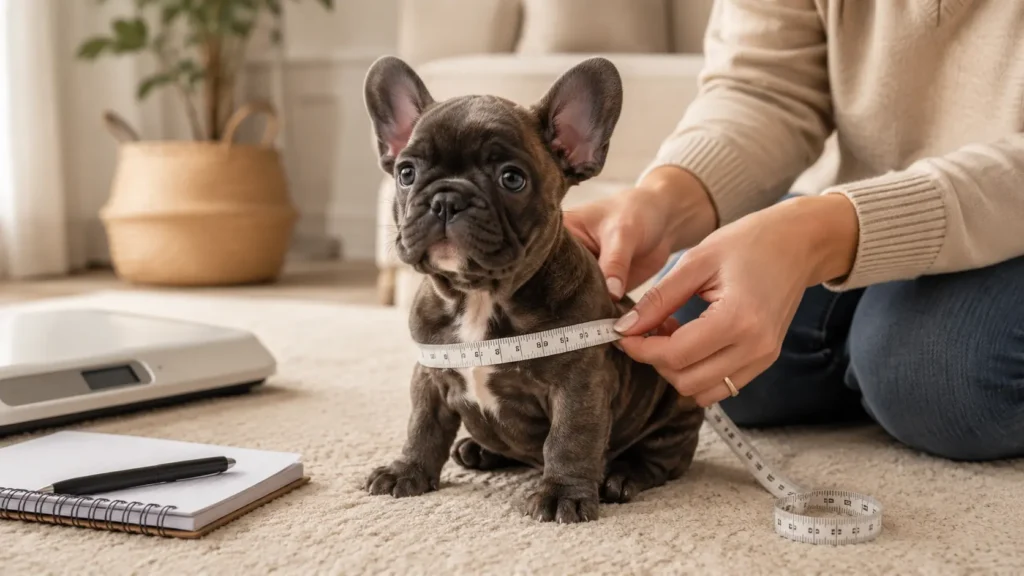
Table of Contents
How Big Do French Bulldogs Get When Fully Grown?
A fully grown French Bulldog is small in height but surprisingly solid in weight. According to the American Kennel Club’s French Bulldog breed information, adult French Bulldogs are generally about 11-13 inches tall and under 28 pounds. Their body is compact, muscular, and heavy-boned, which is why many Frenchies feel heavier than they look when you pick them up.
Good to know: French Bulldogs are compact, muscular, and heavy-boned, so they often feel heavier than they look. Some breeders look at early puppy proportions for clues, but a Frenchie’s final adult shape can still change as height, chest width, muscle, and weight develop.
How Tall Are French Bulldogs?
French Bulldog height is measured from the ground to the top of the shoulder while the dog is standing naturally. Most adult Frenchies finish around 11–13 inches tall, but they do not reach that height overnight. Their legs, chest, and body shape can develop at different speeds, which is why some puppies look awkward during growth.
| Age | Typical Height |
|---|---|
| 3 Months (Puppy) | 4–6 inches |
| 6 Months (Growing) | 7–9 inches |
| 9 Months (Adolescent) | 10–11 inches |
| 12 Months (Near Adult Height) | 11–13 inches |
Knowing your Frenchie’s height helps with everyday decisions, from choosing the right crate to deciding whether ramps or steps are needed for furniture. Just remember that height often settles before the chest, shoulders, and muscle fully fill out.
French Bulldog Male vs Female
Size Differences
Male and female French Bulldogs are usually similar in height, but their body shape can look different. Males often appear broader, heavier, and more muscular, while females are often slightly lighter and more refined. That does not mean every male will be big or every female will be small, but the pattern is common enough for owners to notice.
- • Often heavier, broader, and more muscular
- • May have a wider chest and blockier head
- • Commonly around 20–28 lbs when healthy
- • Usually gives a stockier, more powerful appearance
- • Often slightly lighter and slimmer than males
- • May look more balanced through the chest and waist
- • Commonly around 17–24 lbs when healthy
- • Usually gives a slightly more refined appearance
Real owner tip: males often look more powerful, while females often look slightly more refined. But body condition matters more than gender. A healthy Frenchie should look solid and balanced, not round, bloated, or overweight.
When Do French Bulldogs Stop Growing?
French Bulldogs do not stop growing all at once. Most Frenchies reach most of their height around 9 to 12 months, but their chest, shoulders, muscle, and adult body shape can continue filling out after that. This is why a one-year-old Frenchie may look close to adult size but still not have that fully mature, stocky body yet.
Around this stage, many French Bulldogs are close to their adult height. Your Frenchie may still look slim, leggy, or slightly unfinished, but their standing height is usually getting close to its final range.
After height growth slows down, the body starts filling out more naturally. The chest may widen, muscle tone improves, and the puppy shape slowly becomes more balanced and adult-looking.
Some Frenchies continue looking more mature into their second year. This is when the body can appear stockier, stronger, and closer to the classic compact French Bulldog shape.
Simple answer: French Bulldogs usually stop getting taller before they stop filling out. Height may settle around the first year, while chest width, muscle, and adult body shape can continue developing after that.
French Bulldog Growth Stages by Age
Frenchie growth is not just about getting heavier every month. Different parts of the body develop at different speeds. First comes fast puppy growth, then height starts to settle, and later the chest, shoulders, and muscle begin to fill out.
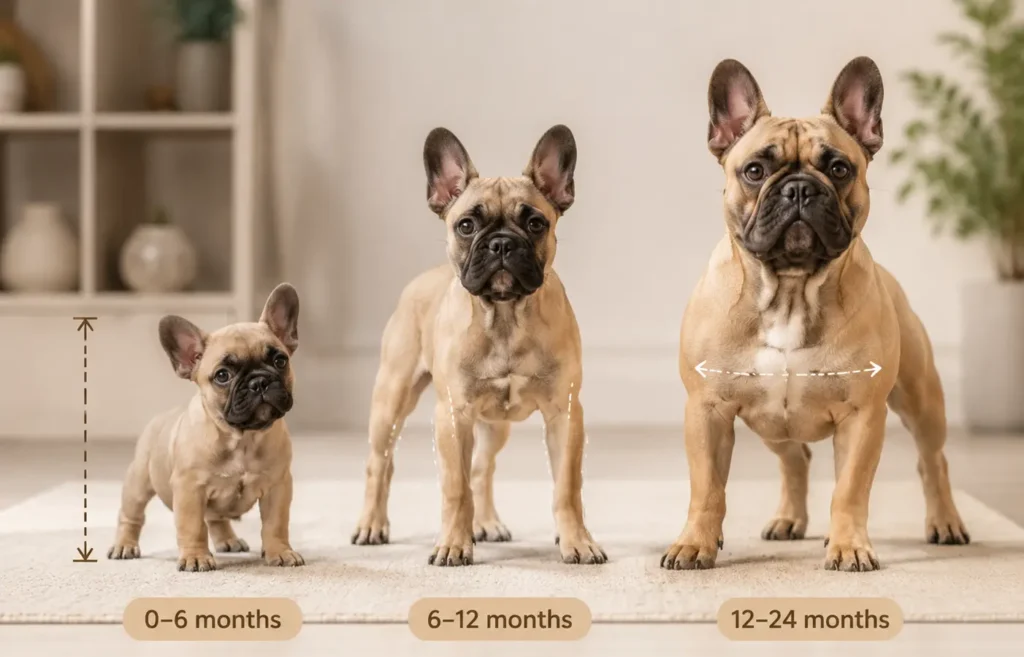
Rapid bone development happens during this stage. Height can increase quickly, and some puppies may look lanky, uneven, or all legs for a while.
Height growth begins to slow down, but the body may still look slim while the chest, shoulders, and muscle catch up. This is a common stage for awkward proportions.
The chest may widen, muscle develops, and the classic compact French Bulldog shape becomes more noticeable. This is when many Frenchies start looking stronger, sturdier, and more adult.
Why Do French Bulldog Puppies Look Awkward While Growing?
French Bulldog puppies can go through a funny-looking stage where they suddenly seem too long, too slim, or all legs and ears. For new owners, this can be confusing, especially if the puppy looked round and compact a few weeks earlier.
Most of the time, this awkward stage is part of normal growth. A Frenchie’s legs, chest, muscle, head, and body shape do not always develop at the same speed.
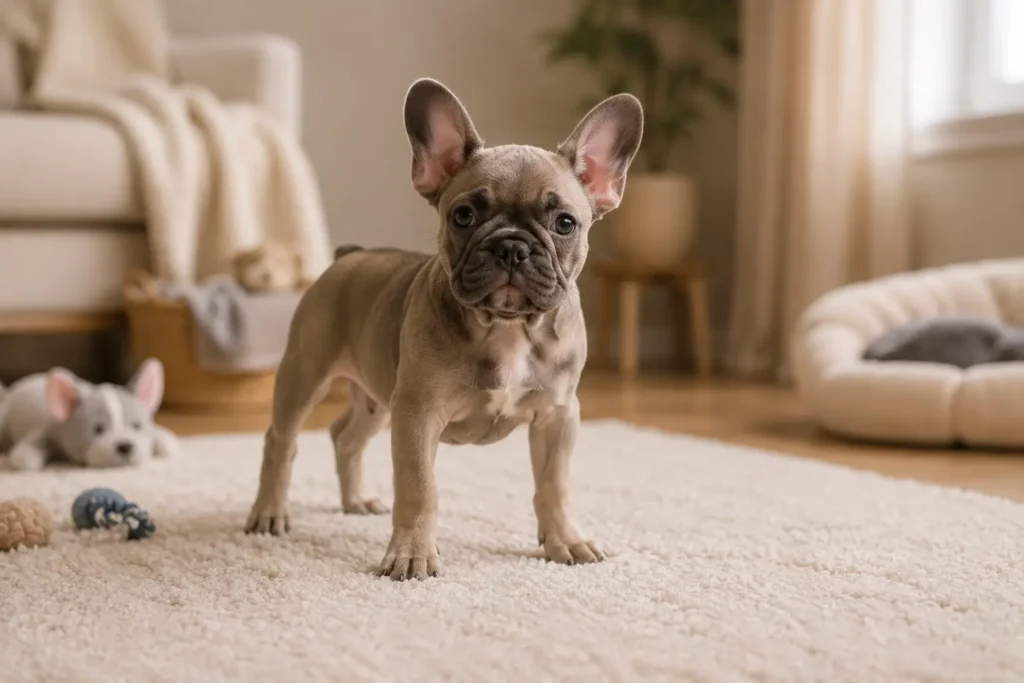
A Frenchie puppy may look awkward because height and bone structure can develop before the chest and muscle fully catch up. That temporary mismatch can make the puppy look narrow, leggy, or less compact for a while.
- Longer-looking legs before the chest fills out
- A slim or narrow body during the teenage stage
- A head that seems large compared with the body
- Uneven proportions while muscle is still developing
- A less compact look before adult shape settles
Good to know: awkward does not always mean unhealthy. But if your puppy has limping, pain, sudden weight loss, weakness, or no steady growth for several weeks, that is different and should be checked by a vet.
Birth to 15 Weeks: Early French Bulldog Puppy Development
Before the monthly growth chart begins, French Bulldog puppies go through a very fragile early stage. The numbers below are only general guideposts, but they help owners understand what usually happens from newborn size to the early pickup or travel age.
A newborn French Bulldog puppy is usually tiny and fragile, often only a few ounces. In the first days, the focus is warmth, nursing, and steady weight gain.
Between 4–8 weeks, puppies begin walking better, socializing more, eating more solid food, and showing early body structure.
Many Frenchie puppies are around 4–7 lbs by this stage, though size can vary. This is often when puppies are becoming more social, active, and ready for a more structured puppy routine.
Some Frenchie puppies may be closer to 8–15 lbs by 13–15 weeks, depending on genetics, feeding, and health. Always follow breeder, vet, airline, and local rules before travel.
Good to know: do not judge final adult size too early. A small puppy can still grow into a sturdy adult, and a chunky puppy can slim out during the awkward growth stage.
French Bulldog Puppy Weight Chart by Month
A French Bulldog growth chart should be used as a guide, not a strict rule. Some puppies grow faster early, some fill out later, and males are often heavier than females. What matters most is steady growth, healthy body condition, and no sudden drops in weight or energy.
| Age | Male Weight | Female Weight | Stage |
|---|---|---|---|
| 1 Month | 4–7 lbs | 3–6 lbs | Early development |
| 2 Months | 9–12 lbs | 7–10 lbs | Socialization stage |
| 3 Months | 10–14 lbs | 8–12 lbs | Rapid growth |
| 4 Months | 12–16 lbs | 10–15 lbs | Bone development |
| 5 Months | 15–20 lbs | 11–17 lbs | Active puppy phase |
| 6 Months | 17–22 lbs | 13–20 lbs | Height developing |
| 8 Months | 19–26 lbs | 15–22 lbs | Growth slowing |
| 12 Months | 20–28 lbs | 17–24 lbs | Near adult size |
Important: do not panic if your puppy is a little above or below these ranges. A growth chart is only useful when you look at the full pattern: appetite, energy, body condition, stool quality, and steady weight gain over time.
What Affects a French Bulldog’s Final Size?
A French Bulldog’s final size is not decided by one thing. Two Frenchies from the same breed can grow differently because genetics, food quality, activity level, health, and body condition all play a role. That is why one Frenchie may look compact and stocky, while another looks smaller, slimmer, or slower to fill out.
Parent size, bone structure, and natural body type have a major influence on how big, compact, or stocky a Frenchie becomes.
Good food supports healthy growth, but overfeeding can create extra fat instead of healthy muscle and structure.
Gentle daily movement helps build strength and coordination. High-impact jumping should be limited while joints are still developing.
Parasites, illness, poor appetite, or ongoing digestive issues can affect steady growth and should be discussed with a vet.
Important: a bigger Frenchie is not automatically a healthier Frenchie. The goal is steady growth, comfortable movement, healthy breathing, and a body shape that looks solid without being overweight.
Warning Signs You Should Never Ignore
Most growth differences are normal, but some signs should not be ignored. If your French Bulldog puppy suddenly stops gaining weight, seems weak, limps, loses appetite, or looks painful when moving, it is better to check with a vet instead of waiting too long.
- No weight gain for several weeks
- Sudden weight loss
- Lack of appetite
- Extreme tiredness or weakness
- Limping or stiffness
- Pain when walking, standing, or being picked up
- Bloated belly with poor growth
- Vomiting, diarrhea, or ongoing digestive issues
Important: growth charts are helpful, but they cannot diagnose a puppy. If your Frenchie looks weak, painful, or suddenly different, use the chart as a clue, not as a replacement for veterinary advice.
Big Frenchie vs Healthy Frenchie: Bigger Is Not Always Better
Many owners worry when their French Bulldog looks smaller than another Frenchie online. But size alone does not prove health. A bigger Frenchie is not automatically stronger, and a smaller Frenchie is not automatically underdeveloped. What matters more is body condition, breathing comfort, movement, energy, and steady growth.

A Frenchie can be heavy because of extra fat, not healthy muscle. Extra weight can make breathing, heat tolerance, and joint comfort harder.
A healthy French Bulldog should look compact, sturdy, and active, with a visible waistline and ribs that can be felt with gentle pressure.
Owner mindset: do not chase the biggest Frenchie. Aim for the healthiest Frenchie your dog’s genetics can support. Because French Bulldogs are flat-faced, extra weight can make breathing and heat tolerance harder, especially in a breed already associated with brachycephalic obstructive airway syndrome.
What Is a Healthy Weight for a French Bulldog?
A healthy French Bulldog weight is not just a number on the scale. Two Frenchies can weigh the same but look very different depending on muscle, bone structure, age, and body fat. Because French Bulldogs are flat-faced and compact, extra weight can make breathing, heat tolerance, and joint comfort harder. That is why body condition scoring matters just as much as the weight chart.
- A visible waistline when viewed from above
- Ribs that can be felt with light pressure
- A solid, muscular body without looking round or bloated
- Comfortable movement without stiffness or strain
- Normal energy for their age
- Breathing that does not become difficult from normal activity
Simple check: if your Frenchie has no waistline and feels like a round barrel, they may be carrying extra weight even if they still look “cute.”
What Size Crate Does a French Bulldog Need?
French bulldog crate size matters because a frenchie should have enough room to stand, turn around, and lie down comfortably. Too small feels cramped. Too large can make puppy training harder because the space no longer feels like a cozy den.
- Standing comfortably
- Turning around easily
- Lying down fully
- Resting without being squeezed
Puppy tip: an adult-sized crate with a divider is often useful because you can adjust the space as your Frenchie grows. For sleep comfort and room temperature, see our guide on whether Frenchies get cold at night.
French Bulldog Neck Size and Harness Size
French Bulldogs have compact bodies, thick necks, broad chests, and strong shoulders, so collar and harness sizing can be tricky. Instead of guessing by breed name, always measure your Frenchie’s neck and chest with a soft measuring tape, then compare those numbers with the brand’s size chart.
- Fit snugly without rubbing the armpits
- Allow free shoulder movement
- Avoid pressure directly on the throat
- Stay secure without squeezing the chest
- Be checked again as your puppy grows
Fit tip: because Frenchies are flat-faced, many owners prefer a comfortable harness over a neck-only collar for walks. The best harness size for a French Bulldog is the one that fits your dog’s actual neck and chest measurements, not just the breed label.
How to Ensure Healthy French Bulldog Growth
Healthy growth is not about rushing your Frenchie to become bigger. It is about supporting steady development while protecting joints, breathing, digestion, and body condition.
Use quality puppy food and adjust portions based on body condition, not just appetite. For simple low-calorie snack ideas, see our guide on whether French Bulldogs can eat cucumber.
Limit repeated jumping from beds, couches, or stairs while the puppy is still developing. For more detail, read our guide on IVDD in French Bulldogs.
Frenchies can overheat quickly, so avoid heavy exercise in hot weather and keep walks gentle.
Check weight trends, appetite, energy, stool quality, and movement instead of obsessing over one number.
Best habit: take monthly photos from the side and top. They help you notice body changes that the scale alone cannot show.
The Bottom Line
A French Bulldog’s growth is not a perfectly straight line. Your puppy may look tiny, round, leggy, slim, chunky, or awkward at different stages.
Most adult Frenchies are small in height but solid in build, usually around 11–13 inches tall and commonly around 17–28 pounds, depending on sex, genetics, structure, and body condition.
The real goal is not the biggest Frenchie. The goal is a healthy Frenchie with steady growth, comfortable movement, healthy breathing, and a balanced body shape.
Let your Frenchie grow at their own pace. Healthy beats huge.
French Bulldog Size and Growth FAQs
Here are quick answers to the most common questions owners ask about French Bulldog size, puppy growth, adult weight, and healthy body shape.
How big do French Bulldogs get when fully grown?
Most adult French Bulldogs are about 11–13 inches tall at the shoulder and commonly weigh around 17–28 pounds, depending on sex, genetics, structure, muscle, and body condition.
When do French Bulldogs stop growing?
Many French Bulldogs reach most of their adult height around 9–12 months, but their chest, shoulders, muscle, and adult body shape can continue filling out after that.
At what age is a French Bulldog full grown?
A French Bulldog may look close to adult height around the first year, but full body maturity can take longer. Some Frenchies continue looking stockier and more mature into their second year.
How much should a French Bulldog weigh?
Many healthy adult French Bulldogs fall around 17–28 pounds. However, weight alone is not enough. A healthy Frenchie should have a visible waistline, ribs that can be felt with light pressure, and comfortable movement.
Are male French Bulldogs bigger than females?
Often, yes. Male French Bulldogs may look broader, heavier, and more muscular, while females are often slightly lighter and more refined. But individual genetics and body condition matter more than gender alone.
Why does my French Bulldog puppy look skinny or awkward?
Frenchie puppies can go through an awkward growth stage where height, legs, chest, muscle, and head shape develop at different speeds. This can make them look narrow, leggy, or unfinished for a while.
Is a bigger French Bulldog healthier?
No. Bigger does not automatically mean healthier. A Frenchie can be heavy because of extra fat, not healthy muscle. The goal is a balanced body shape, easy movement, comfortable breathing, and steady growth.
What size crate does a French Bulldog need?
Many adult French Bulldogs do well with a crate around 24–30 inches, depending on their body length and build. The crate should allow them to stand, turn around, and lie down comfortably.
Should I worry if my Frenchie is smaller than the growth chart?
Not always. Growth charts are only guides. What matters most is steady growth, good appetite, normal energy, healthy stool, comfortable movement, and your vet’s assessment.
Sources Checked
For this guide, we reviewed breed-standard and veterinary references to support the sections on French Bulldog size, weight, body condition, breathing risk, and healthy growth.
Used for official breed size information, including French Bulldog height and weight guidance.
Used for breed-standard details about weight, compact proportions, muscular build, and heavy bone.
Used for body condition guidance, including rib feel, fat coverage, and healthy weight assessment.
Used for information about flat-faced breeds, French Bulldogs, breathing difficulty, and BOAS risk.

Veterinary Disclaimer: The information provided on The Breed Expert is for general educational and informational purposes only. It is not intended as a substitute for professional veterinary advice, diagnosis, or treatment. Always consult your veterinarian if your French Bulldog shows sudden weight loss, no steady growth, poor appetite, vomiting, diarrhea, limping, stiffness, breathing difficulty, overheating, weakness, pain, or any sudden change in health.
Pingback: 50 French Bulldog Facts: Interesting, Fun & Important Facts
Pingback: How Much Are French Bulldog Puppies? Cost Guide