
French Bulldogs have a special talent for looking deeply offended while doing absolutely nothing wrong.
One minute, a Frenchie is snoring on the sofa like a tiny freight train. The next, they are chasing a toy, demanding a snack, or staring at you as if you have personally ruined their afternoon.
That combination of comedy, affection, stubbornness, and very distinctive looks is a big part of the breed’s appeal. But behind those famous bat ears and squishy faces is a surprisingly complicated little dog.
Some French Bulldog facts are simply fun. Others explain why the breed behaves the way it does, why certain everyday precautions matter, and why buying a Frenchie based only on appearance can be a mistake.
So here are 50 French Bulldog facts, mixing history, appearance, personality, health, care, breeding, and a few facts that may genuinely surprise you.

French Bulldog Facts at a Glance
Before getting into the history, personality, and health details, here’s a quick snapshot of the breed’s most useful basics.
| Trait | Quick Fact |
|---|---|
| Common nickname | Frenchie |
| Type | Companion dog |
| Size | Small, compact and muscular |
| Typical height | About 11–13 inches |
| AKC weight limit | 28 pounds |
| Coat | Short and smooth |
| Ears | Upright “bat ears” |
| Temperament | Affectionate, alert, playful and adaptable |
| Exercise | Moderate, with breed-specific limitations |
| Swimming | Generally poor swimmers |
| Heat tolerance | Limited; careful heat management is important |
| Lifespan | About 10–12 years as an AKC general estimate |
| Main body characteristic | Brachycephalic, or short-skulled, facial structure |
Table of Contents
Interesting French Bulldog Facts
There is more to the French Bulldog than its unmistakable face. From its unusual journey from England to France to the history behind those famous bat ears, the breed has a story that is surprisingly colorful.
1. French Bulldogs aren’t actually originally from France
This is probably the first fact worth knowing.
The breed’s story starts with small Bulldog-type dogs in England, particularly around Nottingham, where lace workers kept smaller Bulldogs as companions. When some lace workers moved to France during the Industrial Revolution, they brought their dogs with them.
The little dogs became popular in France, particularly in Paris, and eventually became known as the French Bulldog.

So technically, their passport story is a little more complicated than their name suggests.
2. The breed’s history involves three countries
England provided the foundation, France helped develop the distinctly French type, and American breeders played a major role in establishing the breed standard that made the upright bat ear such an important feature.
The French Bull Dog Club of America describes England, France, and America as the three particularly important countries in the breed’s development.
3. They were bred as companion dogs
French Bulldogs weren’t created to herd sheep, retrieve game, or spend eight hours running through a field.
Their role was much closer to “please sit beside me and make the room more entertaining.”
The FBDCA describes the French Bulldog as a companion dog, and its breed information emphasizes its affectionate and adaptable nature.
4. Their famous bat ears weren’t always universally accepted
Today, those upright ears are one of the quickest ways to recognize a Frenchie.
Historically, however, both rose ears and upright ears appeared in European French Bulldogs. American fanciers strongly preferred the upright ear and eventually incorporated the bat ear into the American breed standard.
5. A disagreement over ears helped inspire the first American French Bulldog club
This sounds like the world’s most niche dog-show argument, but it actually mattered.
According to the FBDCA’s history, an 1897 Westminster controversy over which ear type should prevail helped prompt American French Bulldog enthusiasts to organize and create a breed standard.
6. The French Bulldog Club of America was founded in 1897
The FBDCA says it was formed in 1897 and was the first club in the world dedicated exclusively to the French Bulldog.
7. Frenchies became closely associated with Paris
Once established in France, the breed became part of Parisian social life and was associated with artists, entertainers, and fashionable circles.
That history is one reason the Frenchie still carries a rather glamorous reputation despite spending much of modern life trying to steal someone’s dinner.
8. French Bulldogs even appeared in artwork
The AKC notes that artist Henri de Toulouse-Lautrec included French Bulldogs in several of his paintings.
So your Frenchie may not know it, but apparently the breed has had an artistic career for quite a while.
9. A French Bulldog is recorded as having been aboard the Titanic
The AKC documents a French Bulldog named Gamin de Pycombe as one of the dogs aboard the Titanic. His owner survived; the dog did not.
It is a fascinating piece of breed history, although obviously not one of the happier Frenchie facts.
10. The French Bulldog was recognized by the AKC in 1898
The American Kennel Club officially recognized the French Bulldog in 1898, giving the breed more than a century of AKC history.
French Bulldog Appearance Facts
Those unmistakable ears, wrinkles, and compact build make the Frenchie instantly recognizable.
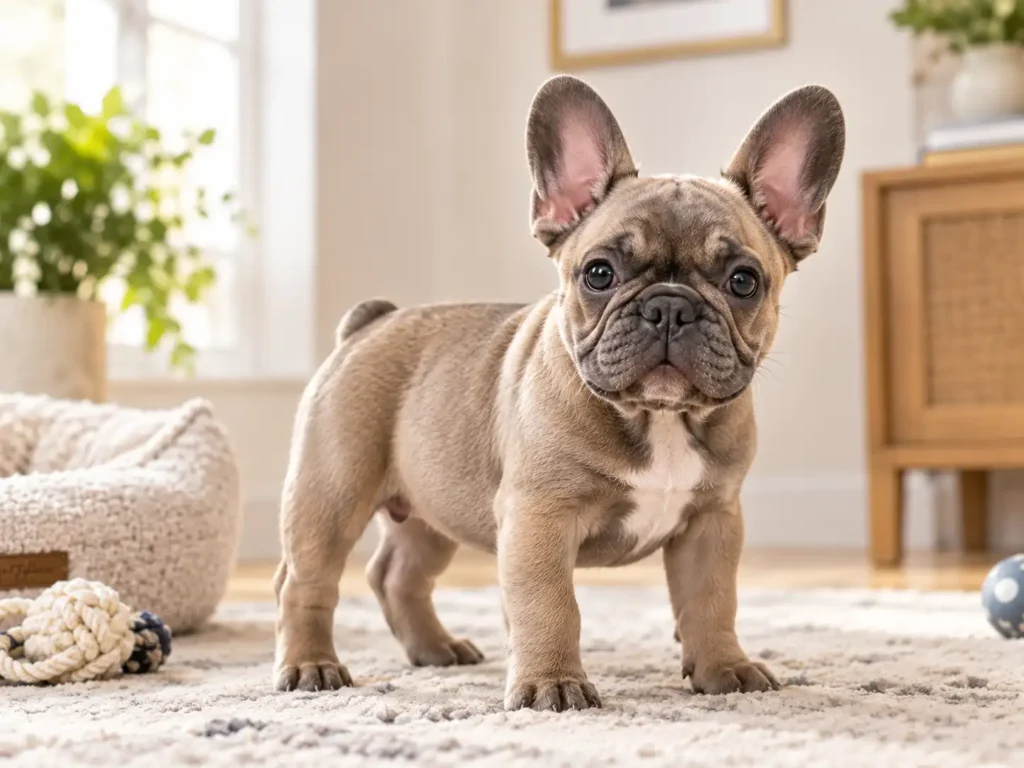
11. Those ears are officially called “bat ears”
The description isn’t just a cute nickname.
The breed standard calls for ears that are broad at the base, elongated, rounded at the top, set high on the head, and carried erect with the opening facing forward.
12. Frenchies are small, but they aren’t delicate
The breed standard describes them as muscular, heavy-boned, and compact.
That is why a Frenchie can look like a small lapdog but feel surprisingly solid when they decide your lap belongs to them.
12. Frenchies are small, but they aren’t delicate
The breed standard describes them as muscular, heavy-boned, and compact.
That is why a Frenchie can look like a small lapdog but feel surprisingly solid when they decide your lap belongs to them. For a closer look at Frenchie growth, adult size, and weight, see our French Bulldog Size Chart & Growth Guide.
13. Their body is supposed to look compact and balanced
A properly proportioned French Bulldog has a short, rounded body, broad chest, muscular limbs, and a distinctive topline. The breed is short in stature without being fine-boned or fragile-looking.
14. Their tails are naturally short
French Bulldogs have naturally short tails that can be straight or screwed, according to the breed standard. So a tiny tail isn’t automatically the result of docking.
15. They have a short, smooth coat
Frenchies have a short, smooth coat rather than a long or fluffy standard coat. And yes, short-haired does not mean “doesn’t shed.” Your black shirt has received that memo already.
16. French Bulldogs come in several recognized colors and patterns
Under the FBDCA/AKC breed standard used in the United States, accepted colors include white, cream, and fawn, along with recognized markings and patterns such as brindle, piebald, black masks, black shading, and white markings.
Other registries and countries can have differences in their standards, so “recognized” should always be understood in context.

17. A fashionable color isn’t automatically a standard color
Some Frenchie coat colors have become extremely popular online, but popularity and breed-standard acceptance are not the same thing.
The current FBDCA standard lists several colors and patterns as disqualifications in its show standard, including blue, blue fawn, liver, merle, and several black-based combinations.
If you’re trying to make sense of the different Frenchie colors and patterns, our Frenchie Colors Chart breaks them down in more detail.
18. Their face is an example of brachycephaly
Brachycephalic simply means having a shortened, broad skull shape. French Bulldogs are one of the breeds commonly classified as brachycephalic.
That short face is undeniably cute, but it also affects breathing and heat management, which is where appearance becomes a practical ownership issue.
19. Their facial wrinkles are part of the breed’s look
The breed standard describes loose skin and wrinkles, particularly around the head and shoulders.
Those folds can collect moisture and debris, however, so cute wrinkles still need sensible care.
20. Their weight shouldn’t be judged by looks alone
Two Frenchies can look completely different while being healthy at different weights.
The breed standard gives a 28-pound maximum for the standard, but individual body condition, muscle, frame, age, and overall health all matter. Your veterinarian is in a much better position than a social-media photo to tell you whether your Frenchie is carrying an appropriate amount of weight.
10 Fun Facts About French Bulldogs
Here are some of the quirky little details that make living with a Frenchie so entertaining.
21. Frenchies can be surprisingly expressive
Those wide eyes, pushed-up lips, upright ears, and dramatic little faces make even an ordinary Tuesday look like an emotional event.
That is subjective rather than a scientific measurement, of course, but their physical structure certainly gives the breed a very distinctive range of facial expressions.
22. They can be playful without being nonstop athletes
The breed standard describes French Bulldogs as generally active, alert, and playful, but not unduly boisterous.
In everyday life, that can mean bursts of energy followed by an extremely serious commitment to sofa time.
23. They can be stubborn and affectionate at the same time
Frenchies have a reputation for having strong opinions.
A dog can adore you, follow you around the house, and still look directly at the command you just gave them as though it requires legal review.
That doesn’t mean every Frenchie is difficult to train. It means individual personality matters, and patience and reward-based training are useful.
24. They often enjoy human company
French Bulldogs are companion dogs, and the breed is generally described as affectionate and comfortable with people.
That makes them appealing to people who want a dog that’s involved in daily household life rather than mostly independent.

25. Their alert bark doesn’t make them a traditional guard dog
Frenchies may alert their owners when something catches their attention, but they aren’t bred as protection dogs.
Their preferred security system is more likely to be one loud bark followed by checking whether you’re opening a snack cupboard.
26. They can make a remarkable variety of noises
Snorts, grunts, little huffs, sighs, squeaks, and other odd sounds are part of life with many Frenchies.
Some vocalizations are simply part of their personality. But persistent or worsening noisy breathing should not automatically be dismissed as “just a Frenchie thing,” particularly when it comes with exercise intolerance or breathing difficulty. Studies of French Bulldogs have found substantial associations between the breed and upper-airway disorders.
27. Their small size doesn’t make them low-maintenance
This is one of the most useful French Bulldog facts to remember.
They may not need the same amount of physical activity as a high-drive working breed, but their anatomy can create specific management needs involving heat, breathing, skin, weight, water safety, and other health concerns.
28. French Bulldogs belong to the AKC’s Non-Sporting Group
Despite their athletic-looking little bodies, French Bulldogs are classified by the American Kennel Club as part of the Non-Sporting Group.
The group includes breeds with very different histories and jobs, but Frenchies are classified as companion dogs rather than working or sporting dogs.
29. A Frenchie can have a surprisingly big personality
Their size is modest. Their opinions are not.
French Bulldogs can be playful, affectionate, curious, stubborn, social, independent, or some combination of all five before breakfast.
30. No two Frenchies are exactly alike
Breed descriptions tell you about tendencies, not guarantees.
Temperament is shaped by genetics, early experiences, socialization, training, environment, and the individual dog. Even littermates can grow into very different little characters.
French Bulldog Health & Care Facts
This is the section where “cute breed facts” become genuinely useful.
31. Heat is a major consideration for French Bulldogs
Because of their brachycephalic facial structure, French Bulldogs can have less efficient breathing and poorer heat tolerance than dogs with longer muzzles. The AKC specifically recommends careful temperature management and notes that strenuous exercise can be a problem.
For a Frenchie, a hot day isn’t simply a matter of being uncomfortable. It can become a safety issue. For practical tips on keeping your Frenchie safe and comfortable in hot weather, see How to Keep a French Bulldog Cool
32. Panting is how dogs cool themselves, but Frenchies have less room for error
Dogs rely heavily on panting to lose heat. A shortened upper airway can make that process less efficient.
Research on brachycephalic dogs has linked the shortened facial structure with upper-airway problems and reduced heat tolerance.
33. French Bulldogs are poor swimmers
This is one fact every new Frenchie owner should know before the first pool party.
The breed’s front-heavy build and body shape make swimming difficult and potentially dangerous. Both the AKC and FBDCA warn against leaving French Bulldogs unattended around water.
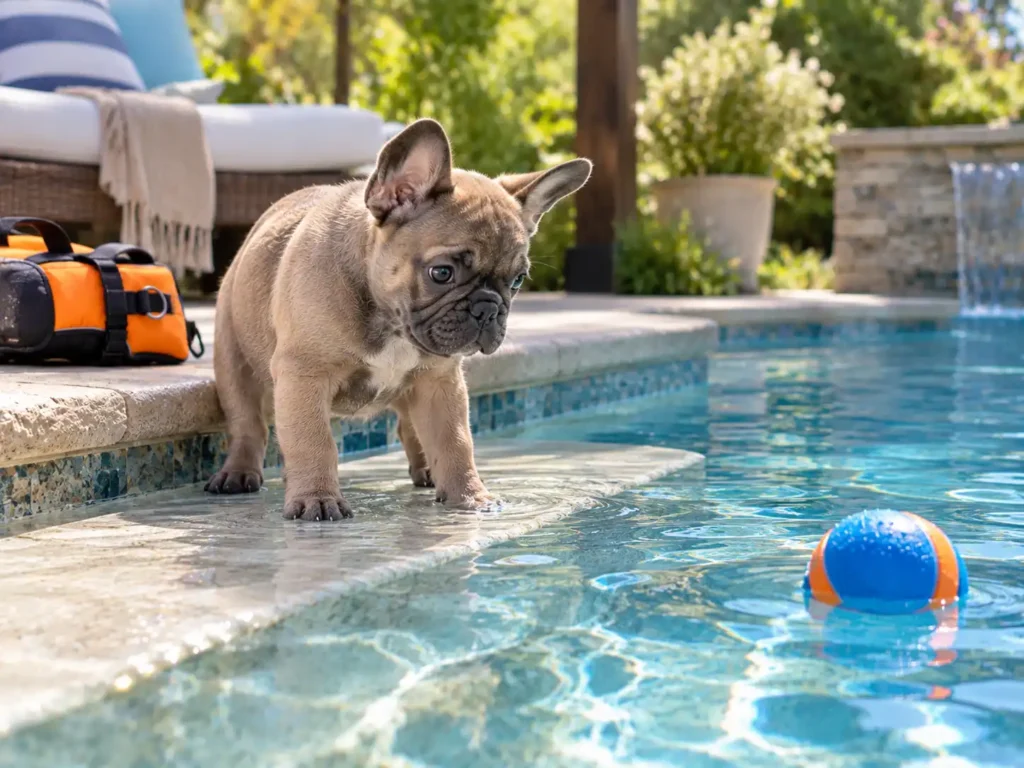
A Frenchie looking confidently at a swimming pool does not mean the Frenchie has suddenly become a Labrador.For a closer look at Frenchie water safety, see our guide Can French Bulldogs Swim?
34. Water play and swimming are not the same thing
A shallow splash area can be very different from deep water.
If your dog enjoys water, keep the environment controlled and supervised. Around pools, lakes, boats, or other deep water, don’t assume that enthusiasm equals swimming ability.
35. French Bulldogs do shed
Their coat is short, but Frenchies still shed. The short hairs can be particularly noticeable on furniture, clothing, bedding, and carpets.
For a closer look at what owners can realistically expect from Frenchie shedding, see Do French Bulldogs Shed?. A short coat makes grooming easier in some ways; it does not make the dog completely hair-free.
36. Frenchies aren’t hypoallergenic
There is no truly hypoallergenic dog breed.
French Bulldogs still produce the proteins involved in dog allergies, along with dander and shed hair. A short coat doesn’t remove the allergen problem.
37. Skin folds need sensible maintenance
Moisture and debris can collect in folds, particularly around the face and other tucked areas.
The goal isn’t to obsessively clean every wrinkle. It’s to keep problem areas appropriately clean and dry and have persistent redness, odor, discharge, or irritation assessed rather than repeatedly covering it up.
38. Ear problems deserve attention too
Those lovely bat ears are part of the breed’s identity, but ear problems can occur.
The FBDCA’s ear-care guidance notes that otitis externa, or inflammation/infection of the outer ear canal, can be associated with allergies, foreign material, wax, and other factors.
Frequent scratching, head shaking, odor, or discharge is a reason to speak with your veterinarian rather than simply adding more ear cleaner.
39. Allergies can show up in several different ways
French Bulldog allergies aren’t necessarily just “itchy skin.”
Depending on the cause and the individual dog, problems may involve paws, ears, skin, face, gastrointestinal signs, or recurrent skin irritation.
Large-scale veterinary data also show that hypersensitivity/allergy-type problems and ear disease are important health concerns within the breed.
40. Their spine is another area owners should understand
French Bulldogs can have vertebral abnormalities and are also susceptible to intervertebral disc disease.
That doesn’t mean every Frenchie will develop a spinal problem. It does mean that sudden back pain, weakness, difficulty walking, or loss of normal movement deserves prompt veterinary attention. Research has identified IVDD and vertebral abnormalities among recognized health concerns in the breed.

For a deeper look at IVDD signs, risks, and what owners should watch for, see IVDD in French Bulldogs
41. Weight management matters
Extra weight is not just a cosmetic issue for a Frenchie.
Because breathing and heat tolerance are already important considerations, maintaining a healthy body condition can make everyday life easier on the dog.
Your Frenchie may strongly disagree when dinner ends. The veterinarian still gets the deciding vote.
42. Frenchies don’t need extreme amounts of exercise
They generally aren’t built for sustained, intense endurance exercise.
The breed does need regular movement and mental stimulation, but activity should be appropriate for the individual dog and environmental conditions. The AKC specifically notes reduced tolerance for heat and strenuous exercise.
43. A Frenchie’s breathing should be judged in context
Some breathing noise is common in brachycephalic dogs, but that doesn’t mean all breathing noise is harmless.
Research in veterinary populations has found French Bulldogs to have a significant burden of upper-respiratory disorders, including brachycephalic obstructive airway syndrome.
A useful rule: know what is normal for your individual dog and pay attention when their breathing, stamina, recovery, or sleeping suddenly changes.
French Bulldog Facts About Buying, Breeding & Living With One
Before bringing home a Frenchie, a few practical facts are worth knowing.
44. The breed can be a good fit for apartment life
French Bulldogs generally adapt well to smaller living spaces, provided they receive appropriate activity, companionship, veterinary care, and a comfortable temperature-controlled environment.
The size of your home matters less than whether the dog’s actual needs can be met.
45. Frenchies should not be chosen for color alone
A rare-looking coat can be tempting, especially when social media is full of unusual shades.
But a healthy airway, sound structure, appropriate temperament, and responsible breeding practices matter considerably more than whether the coat happens to photograph well.
The breed standard itself distinguishes acceptable colors and disqualifying colors/patterns, which is another reminder that “rare” and “desirable” are not synonymous with “better.”
46. Difficult births are a recognized French Bulldog concern
French Bulldogs are among the breeds in which dystocia, or difficult birth, is an important reproductive concern.
A large veterinary study comparing French Bulldogs with other dogs found a markedly increased risk of dystocia in the breed.
That is one reason responsible breeding isn’t simply a matter of putting two attractive dogs together.
47. Breeding should consider much more than appearance
Responsible breeding decisions involve health, temperament, structure, and inherited risk, not just a trendy color or an especially exaggerated face.
Current research continues to document substantial health burdens associated with the breed’s physical characteristics, including airway disease, skin disease, ear disease, spinal problems, and reproductive difficulties.
48. Health testing matters when choosing breeding dogs
Responsible French Bulldog breeding should involve more than choosing two attractive dogs. The AKC currently recommends health screening for breeding dogs that includes patella, hip, cardiac, and ophthalmologist evaluations.
That gives prospective owners something concrete to ask about when evaluating a breeder.
49. French Bulldog care is mostly about knowing the breed’s limits
A Frenchie doesn’t need to live in a bubble.
They can play, walk, travel, and enjoy family life. The trick is knowing when an ordinary dog activity needs a Frenchie-specific adjustment, especially in hot weather, around water, or during strenuous exercise.
50. The most important French Bulldog fact is that the dog in front of you matters
Breed information gives you a starting point. Your individual Frenchie gives you the actual story.
One may be an enthusiastic little athlete. Another may prefer three laps around the living room followed by a six-hour nap. One may have sensitive skin; another may not. One may adore every dog at the park; another may prefer a smaller social circle.
Good Frenchie ownership comes from knowing the breed and paying attention to the individual dog.
That’s much more useful than trying to make every Frenchie fit the same checklist.
French Bulldog Facts People Often Get Wrong
Not everything you hear about Frenchies is quite accurate.
“French Bulldogs are completely French in origin.”
Not exactly. Their development began with small Bulldog-type dogs in England before the breed became established in France.
“They’re small, so they’re easy dogs.”
Not necessarily. Their size can make apartment living practical, but their anatomy creates specific considerations around heat, exercise, breathing, water, and health.
“Short hair means they don’t shed.”
No. French Bulldogs still shed.
“All Frenchies can swim.”
Definitely not something to assume. Their front-heavy body shape makes them poor swimmers and increases drowning risk.
“Snoring and noisy breathing are always normal for the breed.”
That’s too broad. Brachycephalic anatomy can cause respiratory noise, but significant or worsening breathing problems can indicate an underlying disorder and deserve veterinary assessment.
“The rarest Frenchie color must be the most valuable.”
A rare coat isn’t a substitute for health, sound structure, or responsible breeding. Also, coat colors accepted by a breed standard are not identical across every registry or market.
French Bulldog Facts FAQs
French Bulldogs have plenty of entertaining quirks, but some of the most important facts involve their health, care, behavior, and day-to-day needs. These FAQs cover the questions readers commonly have before bringing home or caring for a Frenchie.
What are some facts about French Bulldogs?
French Bulldogs are small, muscular companion dogs known for their short smooth coats, compact bodies, distinctive bat ears, affectionate personalities, and brachycephalic facial structure. They can adapt well to smaller homes, but owners should pay particular attention to heat, breathing, exercise, and water safety.
What are 10 fun facts about French Bulldogs?
Ten fun French Bulldog facts include their English roots, French connection, famous bat ears, Parisian history, appearance in artwork, unusual vocalizations, expressive personalities, companion-dog background, food motivation, and the historical account of a Frenchie aboard the Titanic.
What is an interesting fact about French Bulldogs?
One interesting fact is that the famous upright bat ear became a defining feature partly through a late-19th-century disagreement over ear type among breeders and dog-show enthusiasts. American breeders strongly favored the upright ear when establishing their breed standard.
What are French Bulldog breeding facts owners should know?
One important breeding fact is that difficult birth, or dystocia, is a recognized concern in French Bulldogs. Responsible breeding should also consider health screening, inherited risks, structure, temperament, and overall welfare rather than focusing only on appearance.
Are French Bulldogs good apartment dogs?
They can be. French Bulldogs generally adapt well to smaller living spaces, but apartment living still requires appropriate exercise, mental stimulation, companionship, temperature control, and routine veterinary care.
Do French Bulldogs shed?
Yes. French Bulldogs have short coats, but they still shed. Their short hairs can collect on furniture, clothing, bedding, carpets, and car seats, so a short coat should not be confused with a non-shedding coat.
Are French Bulldogs hypoallergenic?
No. French Bulldogs are not considered hypoallergenic. Their short coats do not eliminate the proteins and other allergens associated with dogs.
Can French Bulldogs swim?
French Bulldogs are generally poor swimmers. Their compact, front-heavy body shape can make deep water dangerous, so they should never be left unattended around pools, lakes, boats, or other deep water.
How long do French Bulldogs live?
Published estimates vary. AKC breed information gives a general life expectancy of about 10–12 years, while longevity research using a large UK dataset has reported a lower median survival estimate. Lifespan is a population estimate rather than a guarantee and can vary with genetics, health, care, and other factors.
What are important facts about French Bulldogs before buying one?
Important considerations include their short-faced anatomy, heat sensitivity, exercise limitations, poor swimming ability, potential skin and ear problems, respiratory concerns, and the importance of choosing health-conscious breeding rather than focusing only on coat color or appearance.
Are French Bulldogs good for first-time owners?
They can be, but small does not automatically mean easy. A first-time owner should be prepared to learn about breed-specific health needs, keep the dog cool, supervise activity, maintain an appropriate body condition, and recognize changes in breathing or general health.
Final Thoughts
French Bulldogs are an odd little package. They’re compact but sturdy, affectionate but sometimes stubborn, playful but not built for endless exercise, and ridiculously expressive without saying a single human word.
And that’s really the point of learning French Bulldog facts. The interesting information isn’t just the trivia you can repeat at a dog park. It’s the stuff that helps you understand why your Frenchie behaves, moves, overheats, sheds, sleeps, and interacts with the world the way they do.
Once you understand that, the breed’s quirks stop seeming quite so random.
Even the offended-looking face starts to make sense.
Usually.

Medical Disclaimer
This article is provided for general educational and informational purposes only. It is not a substitute for veterinary examination, diagnosis, treatment, or individualized advice. French Bulldogs can have breed-specific health considerations, and the severity of those issues varies between individual dogs. If your Frenchie develops breathing difficulty, collapse, weakness, severe overheating, persistent pain, or another concerning change, contact a veterinarian promptly.
Sources Consulted
The article above draws primarily from breed standards, veterinary organizations, and peer-reviewed veterinary research rather than relying on generic breed-trivia sites.
- American Kennel Club (AKC) — French Bulldog breed information, temperament, size, care, heat, exercise, and swimming considerations.
- American Kennel Club — French Bulldog History — historical development of the French Bulldog, including its English roots, French development, Parisian history, and the Titanic story.
- French Bull Dog Club of America (FBDCA) — Breed Information — breed background, temperament, size, characteristics, and companion-dog history.
- French Bull Dog Club of America — Breed Standard — official breed standard covering appearance, bat ears, weight, coat, colors, markings, and temperament.
- French Bull Dog Club of America — History of the FBDCA — history of the first American French Bulldog club and the late-19th-century bat-ear controversy.
- Royal Veterinary College / VetCompass — French Bulldog Health Research — peer-reviewed comparative research on common disorders and health risks in French Bulldogs.
- VCA Animal Hospitals — French Bulldog — practical breed-specific information covering behavior, exercise, overheating, swimming, grooming, weight, and general care.
- The Kennel Club — Brachycephalic Health Issues — explanation of brachycephalic anatomy and associated health considerations.
Editorial Note: We aim to separate breed traditions and common Frenchie myths from information supported by veterinary research and established breed standards. Because individual French Bulldogs can differ considerably, general breed information should not replace advice from your veterinarian.