
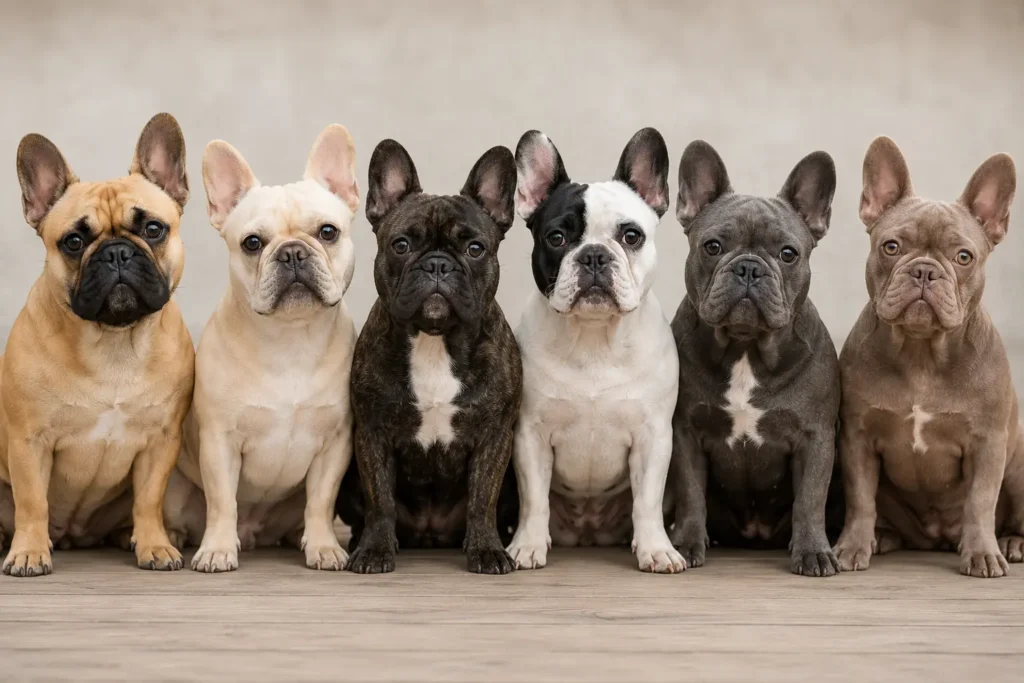
French Bulldogs come in far more shades and patterns than most new owners expect. One Frenchie may be warm fawn with a dark mask, another almost black with fine brindle stripes, while another may have large patches of color across a mostly white coat.
The confusion begins when breeders and social media use names such as blue, lilac, Isabella, platinum, cocoa, pied, merle, and fluffy as though they all describe the same thing.
They do not.
Some terms describe the dog’s base color, others describe a pattern, and “fluffy” refers to coat length rather than color. Certain Frenchie colors are accepted under the American Kennel Club breed standard, while others may be registrable but are disqualifications in conformation showing.
This complete Frenchie colors chart explains what each coat looks like, which colors are recognized, how French Bulldog color genetics work, and what health questions owners should ask before choosing a puppy.
Under the current AKC and French Bull Dog Club of America breed standard, acceptable French Bulldog colors are white, cream, and fawn (ranging from light fawn to red fawn), or combinations of those colors.
- Brindle
- Piebald
- Black masks
- Black shading
- White markings
Disqualified Colors: The standard disqualifies all colors and patterns outside those descriptions, including blue, blue fawn, liver, merle, solid black, black and tan, black and white, and white with black. A heavily brindled Frenchie may look almost black, but it remains brindle when at least a trace of the fawn background is visible.
Important: “Non-standard” does not automatically mean that an individual dog is unhealthy. It means the color does not meet the official breed standard. Health depends on the dog’s full genetics, structure, breeding history, and health testing not color alone.
Frenchie Colors Chart at a Glance
| Color / Pattern | What It Looks Like | AKC Status |
|---|---|---|
| Fawn | Light tan through deep reddish fawn | Accepted |
| Cream | Pale cream or off-white coat | Accepted |
| White | Predominantly or completely white coat | Accepted |
| Brindle | Dark stripes over a fawn background | Accepted pattern |
| Black brindle | Very heavy brindling that appears nearly black | Accepted when brindle is visible |
| Pied or piebald | Mostly white with colored patches | Accepted pattern |
| Fawn and white | Fawn coat with white areas | Accepted combination |
| Brindle and white | Brindle coat with white areas | Accepted combination |
| Blue | Diluted black appearing gray-blue | Disqualifying |
| Blue fawn | Fawn with diluted blue-gray pigment | Disqualifying |
| Chocolate or liver | Brown pigment replacing black | Disqualifying |
| Cocoa | A genetically distinct brown shade found in Frenchies | Not accepted |
| Lilac or Isabella | Diluted brown appearing pale gray-taupe | Not accepted |
| Merle | Mottled patches of diluted and full pigment | Disqualifying |
| Black and tan | Black coat with tan points | Disqualifying |
| Solid black | Black without visible brindling | Disqualifying |
| Fluffy | Longer hair caused by coat-length genetics | Coat type, not a color; disqualifying |
The official standard defines the accepted range narrowly. Online color charts may include many additional shades because they are documenting colors that exist not necessarily colors accepted for showing.
Table of Contents
Color, Pattern and Marking: What Is the Difference?
These three terms are often used interchangeably, but they describe different parts of a Frenchie’s appearance.
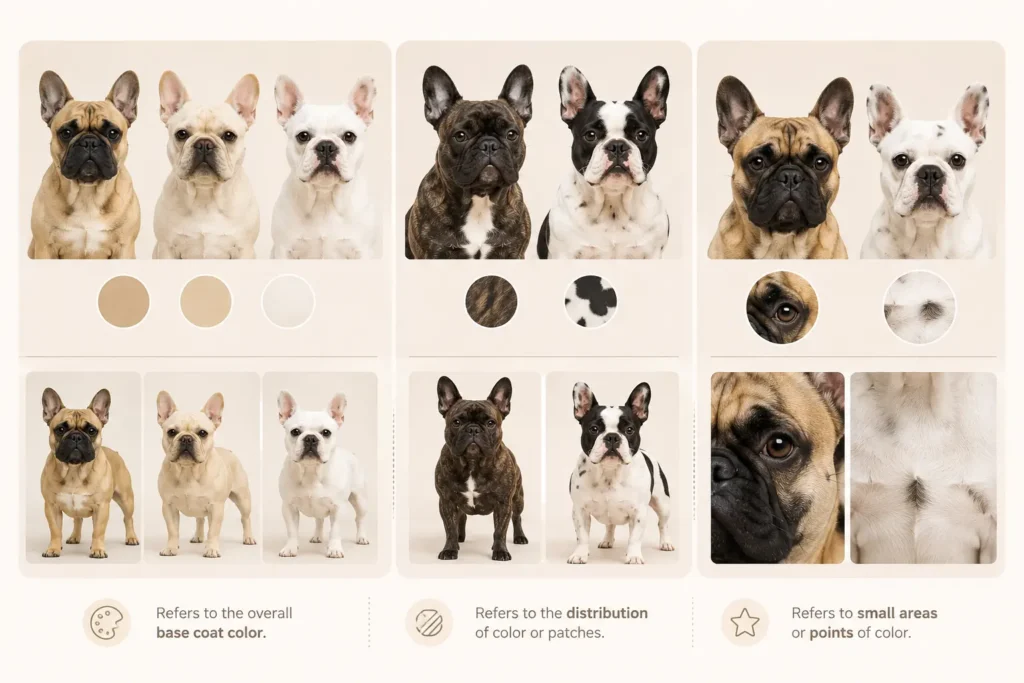
Base Color
The base color is the main pigment you see across the coat.
Examples include:
- Fawn
- Cream
- White
- Blue
- Chocolate
Pattern
A pattern describes how pigment is distributed across the body.
Examples include:
- Brindle striping
- Pied or piebald patches
- Merle mottling
- Tan points
Marking
A marking is a more localized feature layered over the base coat.
Examples include:
- Black facial mask
- White chest
- White blaze
- Black shading
A Frenchie can therefore be described as fawn with a black mask and white chest, or brindle pied with white markings. “Fluffy” belongs to none of these categories. It describes the length and texture of the coat.
How French Bulldog Color Genetics Work
You do not need to memorize genetic codes to understand your Frenchie’s coat. The easiest starting point is that dog coats are primarily built from two pigments:
- Eumelanin: normally produces black pigment
- Phaeomelanin: produces red, yellow, cream, and fawn shades
Different genes control whether these pigments appear, where they appear, and whether they become lighter or diluted.
UC Davis explains that the Agouti, MC1R, K, B, D, and S loci are among the genetic areas influencing French Bulldog coat color and pattern. The interaction between them determines whether a dog appears fawn, brindle, brown, dilute blue, masked, or pied.
Simple Frenchie Color Genetics Chart
| Genetic Area | Simplified Role |
|---|---|
| A locus | Helps control fawn, sable and tan-point distribution |
| B locus | Changes black pigment to brown or liver |
| Co locus | Produces the French Bulldog cocoa shade |
| D locus | Dilutes dark pigment, creating blue or pale brown shades |
| E locus | Affects masks and red, yellow or cream expression |
| K locus | Influences dominant black and brindle |
| S locus | Influences white spotting and pied patterns |
| L locus | Influences short versus long or “fluffy” coats |
DNA testing may help clarify the genes a dog carries, but it should not replace full health screening or responsible breeding decisions. AKC identifies color tests as trait tests and separately recommends patella, hip, cardiac, and ophthalmologist evaluations for French Bulldog breeding stock.
Standard Frenchie Colors and Patterns
French Bulldogs come in several recognized colors and patterns, but they are not all the same visually.
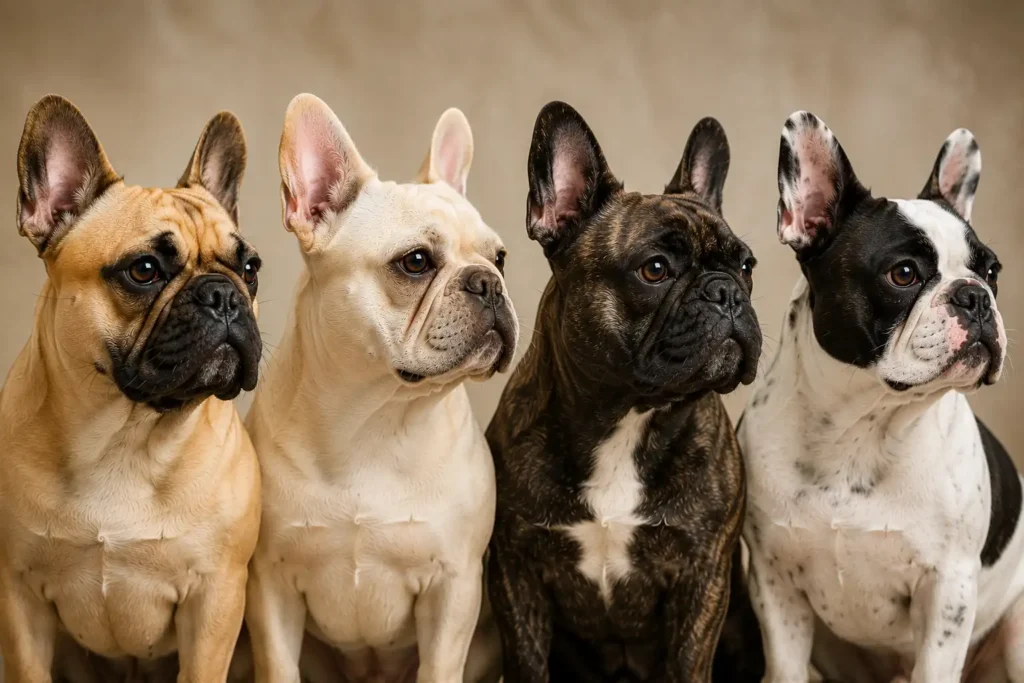
Fawn French Bulldogs
Fawn is one of the most recognizable Frenchie base colors. The official standard allows a broad range, from light fawn to red fawn.
A fawn Frenchie may appear:
- Light beige
- Warm tan
- Golden
- Caramel
- Reddish fawn
Many fawn French Bulldogs have a black facial mask, dark ears, black shading, or a white chest. Others have little or no mask.
Fawn vs Blue Fawn
A standard fawn usually has black pigment around the nose, lips, eyes, or mask. A blue-fawn Frenchie has diluted gray-blue pigment in areas that would otherwise be black.
Although both may have a tan body, blue fawn is specifically listed as a disqualifying color under the AKC standard.
Cream French Bulldogs
Cream Frenchies have a pale, even coat that may range from warm ivory to light buttery cream.
The color should not be confused with:
- White
- Pale fawn
- Platinum
- Albino coloring
Cream is an accepted color in the official breed standard. A cream Frenchie may have dark eyes and a black nose, although the standard permits a lighter nose in cream or fawn dogs without a black mask.
A cream dog may genetically carry other patterns that are hidden because certain genes prevent dark coat pigment from appearing. That is one reason appearance alone does not always reveal everything a dog can pass to puppies.
White French Bulldogs
White is also an accepted Frenchie color. Some white French Bulldogs appear almost completely white, while others have small patches or ticking.
A white coat does not automatically mean that a dog is albino. Albinism is a separate pigment condition that can affect the skin, eyes, nose, and other pigmentation.
Owners should nevertheless pay attention to hearing. Congenital pigment-associated deafness has been documented across dogs with extensive white or piebald pigmentation, although many white and pied dogs hear normally. Coat color alone cannot diagnose hearing loss. A veterinarian can perform or arrange a BAER hearing test when there is concern.
Brindle French Bulldogs
Brindle is a pattern of dark striping over a fawn background.
The stripes may be:
- Fine and widely spaced
- Thick and clearly visible
- So dense that the dog looks almost black
The official standard explains that brindle ranges from sparse black stripes on fawn to an extremely heavy concentration called black brindle. Only a trace of the fawn background needs to be visible for the dog to remain brindle rather than solid black.
Black Brindle vs Solid Black
This distinction is important:
- Black brindle: has at least some visible fawn striping or background and is accepted.
- Solid black: has no trace of brindle and is disqualifying.
Lighting can make a heavily brindled Frenchie look solid black in photographs. Check the shoulders, sides, legs, and areas behind the ears in natural daylight for fine fawn hairs or stripes.
Pied French Bulldogs
A pied or piebald Frenchie has a predominantly white coat with patches of another accepted color or pattern.
Common examples include:
- Fawn pied
- Brindle pied
- White and fawn
- White and brindle
The size, shape, and placement of the patches vary considerably. UC Davis notes that white spotting genetics are complex and can produce variable, often asymmetrical markings.
For an accepted brindle pied, even a trace of brindling inside one colored patch may be sufficient under the breed standard.
Pied vs White With Black
A white Frenchie with true brindle patches can meet the accepted pattern description. However, white with solid black patches and no brindle is listed as a disqualifying color combination.
The difference may be subtle, especially in photographs.
Rare and Non-Standard Frenchie Colors
The following coats exist and are widely advertised as rare Frenchie colors, but they do not meet the current AKC/FBDCA breed standard. This section is descriptive, not promotional. A color being unusual does not make it healthier, better bred, or more valuable as a companion.
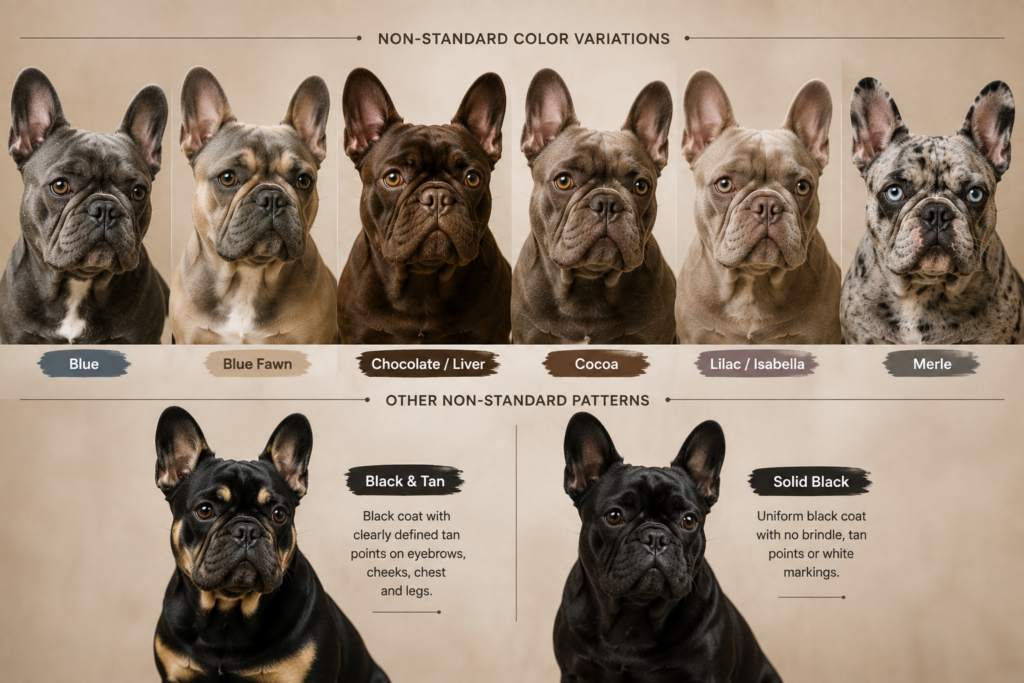
Blue French Bulldogs
A blue Frenchie is not bright blue. Its coat usually appears:
- Slate gray
- Charcoal gray
- Steel blue
- Silvery gray
Blue occurs when recessive variants at the D locus dilute black pigment. UC Davis explains that two dilute variants can change black into a gray-blue shade.
Blue is specifically listed as a disqualifying French Bulldog color under the AKC standard.
Blue Is Not the Same as Gray Brindle
A heavily brindled dog can appear cool-toned in certain lighting. Check the nose, eye rims, mask, and coat roots. True dilution affects black pigment throughout the dog rather than simply making the coat look dark gray in a photograph.
Chocolate, Liver and Cocoa Frenchies
Chocolate or liver coats occur when genes change black eumelanin pigment into brown.
A chocolate Frenchie may have:
- Brown fur
- Brown nose
- Brown eye rims
- Amber or lighter-looking eyes
UC Davis describes the B locus as changing black pigment to brown without changing red or yellow pigment. It also recognizes cocoa as a separate brown shade found in French Bulldogs, historically known as “non-testable chocolate.”
Liver is listed as a disqualifying color under the breed standard. Cocoa and other brown shades fall outside the specifically accepted colors.
Lilac and Isabella French Bulldogs
The terms lilac and Isabella are sometimes used inconsistently by breeders.
In simplified terms, these shades generally involve both:
- Brown or chocolate pigment, and
- Dilution of that pigment.
UC Davis states that dilution can turn chocolate brown into a pale silvery-red shade. It notes that some breeds call this lilac, while the French Bulldog term is typically Isabella.
These dogs may appear:
- Pale gray-brown
- Taupe
- Silvery beige
- Light lavender-gray
Lilac and Isabella are not among the accepted French Bulldog colors described by the AKC standard.
If you want to go deeper into the health side of this color, our guide to Lilac French Bulldog health problems explains what owners should know about Color Dilution Alopecia, skin concerns, breeding practices, and the difference between rare-color marketing and genuine health considerations.
Merle French Bulldogs
Merle is a pattern rather than one solid color. It produces irregular patches where some pigment is diluted while other areas remain fully pigmented.
A merle Frenchie may have:
- Mottled gray and black areas
- Uneven patches
- Blue or partially blue eyes
- Pink areas on the nose or skin
UC Davis describes merle as an incompletely dominant pattern caused by changes associated with the PMEL gene.
Merle is specifically disqualifying under the French Bulldog breed standard.
Why Merle Breeding Requires Special Caution
Merle-to-merle breeding can produce puppies inheriting two copies of merle-related variants. These dogs face an increased risk of serious hearing and vision abnormalities. AKC guidance advises against breeding two merle dogs together.
A dog can also carry a less visible or “cryptic” merle variant, which is why appearance alone is not always reliable for breeding decisions.
Black and Tan French Bulldogs
Black-and-tan Frenchies have a mainly black coat with lighter points commonly appearing:
- Above the eyes
- On the cheeks
- On the chest
- On the lower legs
- Under the tail
This is sometimes called a tan-point pattern.
Black and tan is specifically listed as a disqualifying French Bulldog color pattern.
Some dogs advertised as blue and tan, chocolate and tan, or lilac and tan have the same point pattern combined with different pigment or dilution genes.
Solid Black French Bulldogs
A genuinely solid-black Frenchie has no visible brindle striping.
Solid black is disqualifying, while very dark black brindle may be accepted if there is at least a trace of the fawn background.
Because faint brindling can disappear in poor lighting, identification should be done outdoors or beside a bright window rather than from a single edited photograph.
Fluffy Frenchie Colors
“Fluffy” is not a Frenchie color.
It describes a longer coat associated with recessive variants affecting hair length. Fluffy Frenchies may appear in fawn, cream, brindle, pied, blue, lilac, merle, or other shades depending on their separate color genetics.
The AKC recognizes the French Bulldog as having a brilliant, short, smooth coat. Coats other than short and smooth are a disqualification under the breed standard.
Therefore, a dog may have a standard base color but still be disqualified because of its long coat.
AKC Registration Does Not Equal Breed-Standard Acceptance
This is one of the most confusing parts of Frenchie color discussions.
The AKC breed page may display registration selections for standard and non-standard colors. However, registering a dog or recording its color does not mean that the color is accepted in conformation showing.
The official breed standard is the document that defines which colors, patterns, coats, eyes, and other features meet the conformation standard. Its accepted colors remain white, cream, fawn, and their permitted combinations and patterns.
In other words:
A Frenchie can be registered while still having a color that would be disqualified in the show ring.
Registration also does not certify that the dog has passed health testing.
Does Frenchie Coat Color Affect Health?
Color alone cannot tell you whether an individual French Bulldog will be healthy.
A standard-color dog can have serious hereditary or structural problems, while a non-standard-color dog may appear healthy. The meaningful question is whether the breeder prioritized health, temperament, breathing, structure, genetic diversity, and appropriate screening—not simply the appearance of the coat.
However, certain pigment patterns have specific documented associations worth understanding.
Dilute Coats and Color Dilution Alopecia
Blue, lilac, and Isabella shades involve pigment dilution.
A condition called color dilution alopecia can occur in some dilute-colored dogs. It may cause:
- Thinning hair
- Patchy hair loss
- Dry or scaly skin
- Recurrent skin irritation
- Fragile hairs
The Merck Veterinary Manual explains that color dilution alopecia is associated with genes that turn black or liver pigment into diluted shades. It is documented across several dog breeds, but not every dilute dog develops it.
There is not enough evidence to assume that every blue or lilac Frenchie will develop alopecia. A veterinarian must evaluate hair loss because allergies, parasites, infections, hormonal problems, and friction can cause similar symptoms.
See our guide to French Bulldog allergies for a closer look at the symptoms and common causes.
Merle and Sensory Problems
Merle can be associated with hearing and eye abnormalities, particularly when a dog inherits merle variants from both parents.
Responsible breeding requires genetic knowledge rather than relying on the visible pattern alone.
Extensive White Pigmentation and Hearing
Congenital deafness is associated with certain white and piebald pigmentation genes across multiple breeds. This does not mean every white or pied Frenchie is deaf.
Owners who notice poor sound response, unusual startle behavior, or difficulty locating noises should ask their veterinarian about hearing evaluation or BAER testing.
Health Tests Matter More Than Color Labels
AKC’s French Bulldog testing guidance lists the following core evaluations recommended by the parent club for breeding stock:
- Patella evaluation
- Hip evaluation
- Congenital cardiac examination
- Ophthalmologist evaluation
An echocardiogram is recommended for the cardiac evaluation, although it is not required. Additional genetic tests may help identify inherited variants, but DNA color testing is not a substitute for health screening.
When considering a puppy, ask for documented results rather than accepting statements such as:
- “DNA clear”
- “Vet checked”
- “Rare color”
- “Healthy bloodline”
- “No problems in the parents”
Those phrases do not replace actual test records.
Do Frenchie Puppy Colors Change?
A Frenchie puppy’s underlying inherited color does not simply transform into an unrelated genetic color as the dog grows. However, its shade, contrast, and visible markings can change.
Owners may notice:
- Fawn coats becoming lighter or deeper
- Brindle stripes becoming easier to see
- Puppy fuzz being replaced by a smoother adult coat
- Masks or dark shading becoming less prominent
- Pied patches appearing sharper as the body grows
- Sun exposure affecting the appearance of dark coats
Photography can create even more confusion. Indoor lighting, filters, shadows, and camera white balance may make the same Frenchie look blue, gray, brown, or lilac in different pictures.
When exact identification matters, combine:
- Natural-light examination
- Nose and eye-rim pigment
- Parent colors and pedigree
- Reliable DNA testing
UC Davis offers a coat-color panel specifically tailored to French Bulldogs, covering several genes involved in color and pattern.
How to Identify Your Frenchie’s Color
Start with the base color, then check for patterns, white markings, and the color of the nose and other pigmented areas. Use the quick guide below to narrow down your Frenchie’s likely color before comparing it with the official breed standard.
What Color Is My Frenchie?
Answer a few simple questions about your Frenchie’s coat to narrow down the most likely color or pattern.
What best describes the main coat?
Do you see obvious dark stripes?
Is most of the body white?
What color is the darker pigment?
Frenchie Coat Color
Step 1: Look in Natural Daylight
Avoid judging color from:
- Flash photography
- Warm indoor lighting
- Social-media filters
- Heavily edited breeder pictures
Natural daylight reveals brindling and pigment more accurately.
Step 2: Find the Base Color
Look at areas with fewer white markings, such as:
- Back
- Shoulders
- Sides
- Base of the tail
Decide whether the main shade is fawn, cream, white, black-based, brown-based, or diluted gray.
Step 3: Check for a Pattern
Look for:
- Fine dark brindle stripes
- Large pied patches
- Uneven merle mottling
- Tan points
- White spotting
Step 4: Examine Pigmented Areas
The nose, lips, paw pads, and eye rims may help distinguish black pigment from brown or dilute pigment.
Appearance is still not a substitute for genetic testing because several combinations can look similar.
Step 5: Compare With the Official Standard
Use the AKC/FBDCA descriptions rather than relying entirely on commercial breeder terminology. Names such as “platinum,” “new shade,” and “exotic” may be used differently by different sellers.
Choosing a French Bulldog: Color Should Come After Health
It is normal to prefer a particular coat. However, selecting a puppy primarily because it is advertised as rare can cause buyers to overlook more important factors.
Before placing a deposit, evaluate:
- Breathing and nostril openness
- Movement and body structure
- Temperament
- Parent health records
- Cardiac, hip, patella, and eye results
- Genetic testing relevant to the breeding pair
- Conditions in which the puppies are raised
- The breeder’s willingness to answer difficult questions
- A written contract and return policy
A responsible breeder should be able to discuss both the strengths and limitations of the breeding—not only the puppies’ colors.
A coat may be the first thing you notice, but health, temperament, and responsible breeding determine the life you build with that Frenchie.
Frenchie Color FAQs
Still have questions about French Bulldog colors? Here are quick answers to the most common questions about Frenchie coat colors, patterns, genetics, and non-standard colors.
What Frenchie Colors Are Recognized by the AKC?
The accepted colors are white, cream, fawn from light to red fawn, and combinations of those colors. Accepted patterns and markings include brindle, piebald, black masks, black shading, and white markings.
Is a Blue French Bulldog an AKC-Recognized Color?
No. Blue and blue fawn are specifically listed as disqualifying colors in the current French Bulldog breed standard, even though a blue dog may still have registration paperwork.
What Is the Difference Between a Blue and Lilac Frenchie?
Blue generally results when black pigment is diluted into gray-blue. Lilac or Isabella generally combines brown pigment with dilution, producing a lighter gray-brown or silvery-taupe appearance.
Is Merle a Frenchie Color or Pattern?
Merle is a pattern. It creates irregular areas of diluted and fully pigmented color rather than one uniform base shade.
What Is the Rarest Frenchie Color?
There is no universally recognized “rarest” color. Availability differs by genetic line and location, while terms such as Isabella, platinum, and new-shade are often commercial labels rather than categories in the official standard.
Can Fluffy Frenchies Come in Different Colors?
Yes. Fluffy describes long hair rather than color. A fluffy Frenchie can carry many of the same base colors and patterns as a short-coated Frenchie, but long coats are disqualifying under the AKC breed standard.
Does a Frenchie’s Color Determine Its Health?
No. Color alone cannot predict overall health. Certain pigment genes have documented associations, such as merle-related sensory risks and color dilution alopecia, but responsible health testing, structure, pedigree, and breeding decisions are more informative than color by itself.
Final Verdict
French Bulldog coat terminology becomes much easier once you separate base colors, patterns, markings, and coat type.
The official AKC standard accepts:
✅ Fawn
✅ Cream
✅ White
✅ Brindle patterns
✅ Pied patterns
✅ Permitted combinations and markings
Colors such as blue, chocolate or liver, lilac or Isabella, merle, black and tan, blue fawn, and solid black fall outside the accepted standard.
That distinction should be understood, but it should not become the only way an owner judges a dog. A Frenchie’s wellbeing depends far more on responsible breeding, health screening, functional structure, temperament, and lifelong care than on whether its coat is common or rare.
Use this Frenchie colors chart to identify the coat but use verified health records to evaluate the dog behind it.

Editorial Note
This article is intended for general educational purposes. It does not replace veterinary advice, genetic counseling, hearing or eye testing, or an individual assessment of a French Bulldog.
Coat appearance alone cannot confirm a dog’s genotype, health status, hearing ability, or breeding suitability. Consult a veterinarian and qualified canine genetic-testing service when an accurate assessment is needed.
Sources Consulted
- American Kennel Club — French Bulldog — Official AKC breed information, including French Bulldog colors and markings.
- French Bull Dog Club of America — French Bulldog Breed Standard — Official parent-club breed standard covering acceptable colors, markings, patterns, and disqualifications.
- French Bull Dog Club of America — Interpretation of the French Bulldog Standard on Color — Detailed explanation of acceptable colors, disqualifying colors, and brindle interpretation.
- UC Davis Veterinary Genetics Laboratory — French Bulldog Coat Color Panel — Genetic information covering major loci involved in French Bulldog coat color and pattern.
- UC Davis Veterinary Genetics Laboratory — Dilute (D Locus) — Genetic explanation of dilute pigmentation and related coat-color effects.
- UC Davis Veterinary Genetics Laboratory — Merle — Information about merle inheritance, appearance, and genetic testing.
- American Kennel Club — French Bulldog DNA Tests — AKC information on breed-specific DNA testing and health-related evaluations.
- Merck Veterinary Manual — Hereditary Alopecia and Hypotrichosis — Veterinary information about inherited hair-loss conditions, including color dilution-related disease.
- Louisiana State University School of Veterinary Medicine — Canine Deafness — Veterinary genetics information on congenital deafness and pigment-associated risk.