
French Bulldogs are famous for their tiny tails, but that small feature creates quite a few questions. Do Frenchies actually have tails? Are they born that way? Why do some look straight while others appear screwed or tucked into the body? And when should a short tail become something an owner needs to pay attention to?
The short tail is part of the breed’s natural anatomy, but French Bulldog tails are not all identical. Their shape, length, surrounding skin, and overall structure can vary from one dog to another.
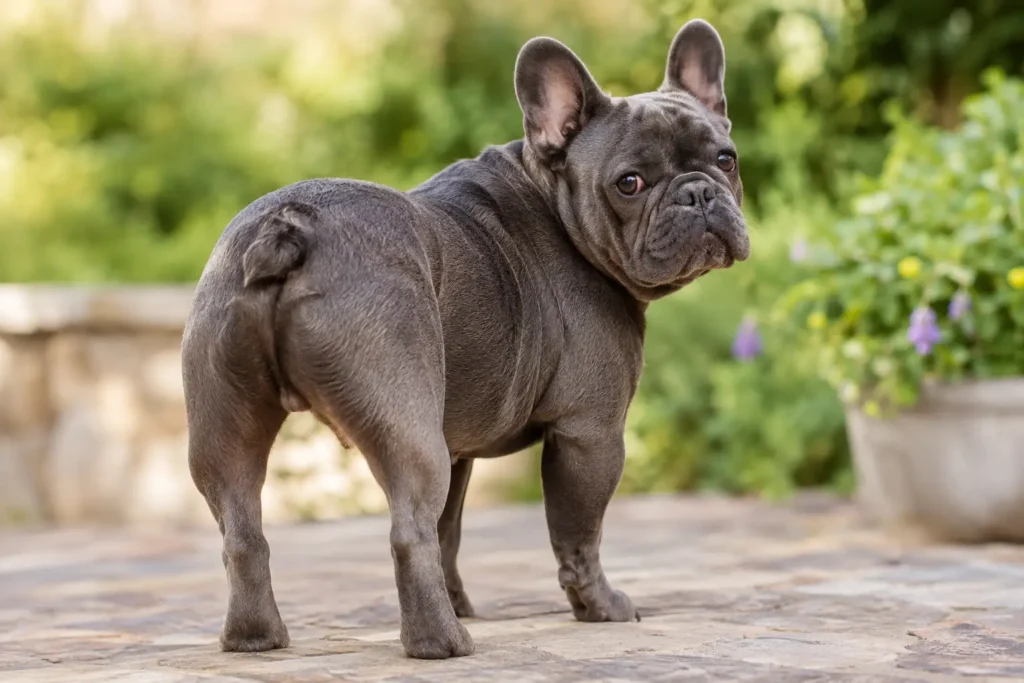
Table of Contents
Do French Bulldogs Have Tails?
Yes, French Bulldogs do have tails. They are simply much shorter than the tails seen on most other dog breeds, which can make a Frenchie look almost tailless from certain angles.
The French Bull Dog Club of America describes the breed’s tail as short, low-set, thick at the root and finer toward the tip. Its breed standard recognizes both straight and screwed tails.
So that little nub you see on the back of a Frenchie is a real tail. It just has a very different shape from the long, flexible tail most people picture when they think of a dog.
Are French Bulldogs Born With Tails?
Yes, French Bulldogs are generally born with their characteristic short-tail structure. Their tail is not simply a normal long tail that is shortened after birth to create the familiar Frenchie appearance.
The short, kinked tail seen in French Bulldogs is associated with inherited genetic changes affecting the development of the tail vertebrae. Research has specifically linked the breed’s screw-tail phenotype with a variant in the DVL2 gene, which is also associated with caudal vertebral abnormalities.
There is still variation between individual dogs. Some Frenchies have a more noticeable short tail, while others have only a very small visible section.
Are French Bulldog Tails Docked?
A naturally short French Bulldog tail does not normally need to be docked.
The Royal Kennel Club’s current French Bulldog breed standard describes the tail as undocked, short, low-set and thick at the root, with a quick taper toward the tip.
That is why a puppy can be born with a tiny tail without having undergone a docking procedure.
There can, of course, be individual cases where a tail has been altered for a medical reason. If you are buying a puppy and the tail history is unclear, ask the breeder what happened and request the veterinary records.
Why Are French Bulldog Tails So Short?
French Bulldogs have been selectively bred for generations for their distinctive body structure, and the short tail is one of the traits that became characteristic of the breed.
The genetics are more complicated than simply saying that Frenchies have “small tails.” Research has connected the screw-tail phenotype with the DVL2 variant and found an association with malformed caudal vertebrae.
This is important because the tail is made from vertebrae too. A Frenchie’s short tail is therefore not just a cosmetic feature sitting separately from the rest of the skeleton.
That does not mean a short Frenchie tail automatically means the dog has a painful spinal condition. The anatomy and the individual dog’s health both matter.
What Does a French Bulldog Tail Look Like?
A French Bulldog’s tail is typically:
- Short
- Low-set
- Thick at the base
- Finer toward the tip
- Straight or screwed
- Carried low when the dog is resting
The French Bull Dog Club of America recognizes both straight and screwed tails, while the Royal Kennel Club standard describes an undocked tail that is preferably straight and long enough to cover the anus.
French Bulldog Tail Types
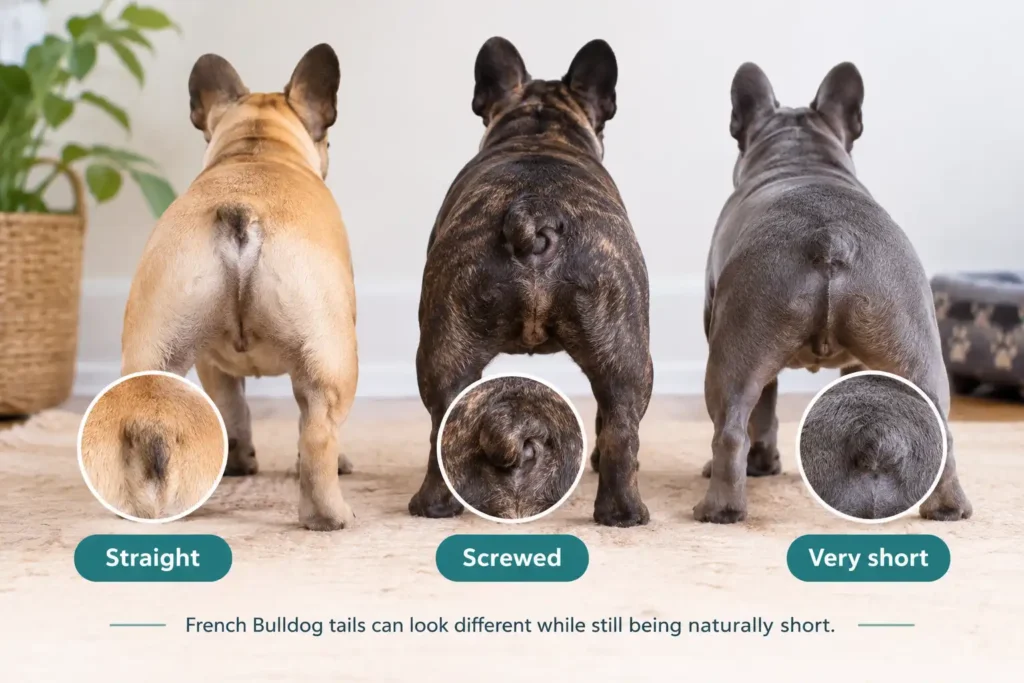
| Tail Type | What It Looks Like |
|---|---|
| Straight | A short tail that extends down from the body without a screw-like twist. |
| Screwed | A short, kinked or twisted-looking tail. |
| Very short | A highly reduced tail that may be difficult to see. |
The breed standard is useful for describing the expected appearance, but tail length alone does not tell you whether an individual dog is healthy.
Can French Bulldogs Have Longer Tails?
Yes. French Bulldog tail length can vary. Some dogs have a slightly more noticeable short tail, while others have a much smaller one. The FBDCA’s judges’ education material specifically notes that both shorter and longer tails can occur and emphasizes that placement and carriage matter more than exact tail length.
So a Frenchie having a tail that looks a little longer than the one you usually see is not automatically a reason for concern.
What matters is whether the tail and surrounding area are comfortable, functional, and free from recurring problems.
Can French Bulldogs Wag Their Tails?
They can move their tails, but don’t expect the broad side-to-side wag you would see from a Labrador or Golden Retriever.
Because the tail is so short and its movement can be limited by its structure, a Frenchie’s excitement may be easier to notice through the whole rear end than the tail itself.
Pay attention to the full body rather than using tail movement as the only sign of mood. A relaxed posture, playful behavior, loose movements and normal interaction with people are more useful clues than how far the tail moves.
What Is a French Bulldog Tail Pocket?
A tail pocket is a fold or indentation of skin around or underneath the tail. Not every French Bulldog has one.
The problem is that a deep, tight fold can trap moisture, skin debris or fecal material. In dogs with corkscrew or tightly curled tails, the surrounding skin can become prone to recurring infection. VCA notes that affected dogs may develop itching, discomfort, foul odor and repeated infections around the tail fold.
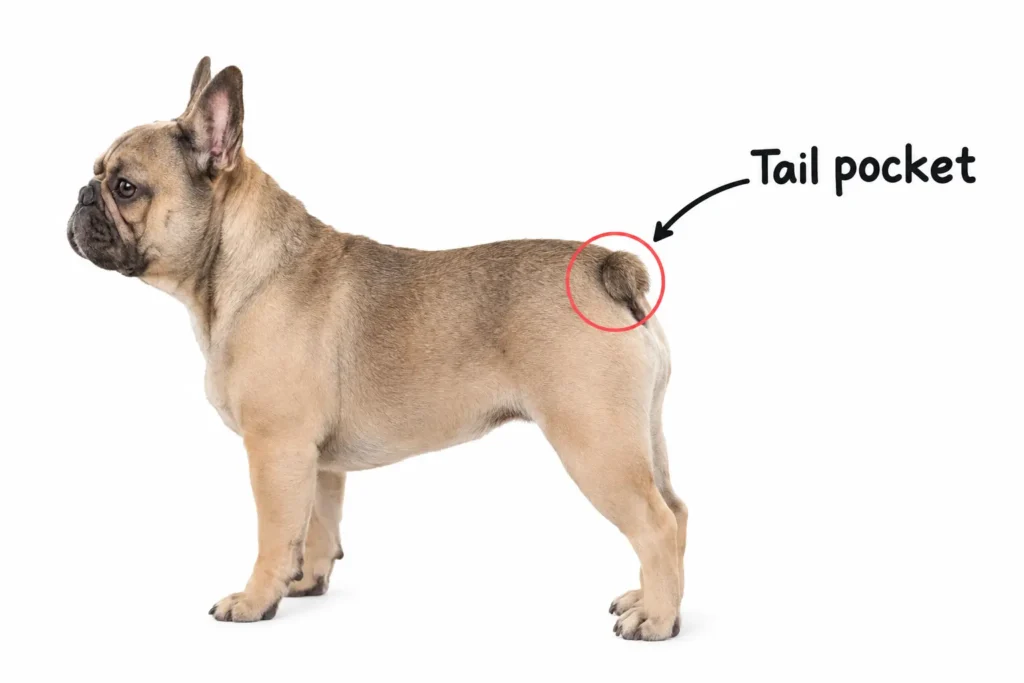
A tail pocket is therefore less about the appearance of the tail and more about what is happening to the skin around it.
How Do You Know a French Bulldog Tail Pocket Is Having a Problem?
A healthy-looking tail area should not constantly smell bad, ooze, bleed or cause your dog to obsessively lick it.
Watch for:
- Persistent bad odor
- Red or irritated skin
- Moist discharge
- Repeated licking or chewing
- Scooting
- Pain when the area is touched
- Recurrent infections
- Difficulty passing stool
These signs do not tell you exactly what is wrong. They simply mean that cleaning the area yourself may not be enough.
VCA notes that corkscrew-tail problems can sometimes require veterinary treatment because the shape of the tail and surrounding folds can make recurring infection difficult to control.
For Frenchies with recurring skin irritation, our French Bulldog Allergies guide covers the broader relationship between skin irritation, yeast, bacteria, allergies and skin folds.
What Does a Healthy French Bulldog Tail Look Like?
This is where appearance and health need to be separated.
A French Bulldog can have a straight or screwed tail and still be healthy. A particular shape does not diagnose a medical problem.
At the same time, the Royal Kennel Club specifically lists a tail that is too short to cover the anus, a screw tail, an inverted tail, or a tight tail among features that deserve attention in French Bulldogs.
The practical question is therefore not:
“Does my Frenchie’s tail look exactly like every other Frenchie’s?”
It is:
“Is the tail comfortable, functional, and free from recurring skin or hygiene problems?”
A tail that causes irritation, interferes with normal hygiene, or appears painful deserves a veterinary examination.
What If a French Bulldog’s Tail Does Not Cover the Anus?
This is worth paying attention to because the tail’s position can affect hygiene.
The Royal Kennel Club’s breed standard says the tail should be long enough to cover the anus. Its Breed Watch guidance separately identifies tails that are too short to cover the anus, along with inverted or tight tails, as features requiring particular attention.
That does not mean every Frenchie whose tail does not completely cover the area automatically has a disease.
It does mean owners should pay attention to hygiene, irritation, stool getting trapped around the skin, and any signs of discomfort.
If the area repeatedly becomes dirty, inflamed or infected, have your veterinarian examine it rather than continually trying different cleaning products.
Is a Short French Bulldog Tail Linked to Spine Problems?
There is a genuine connection between the breed’s tail structure and its vertebrae, but the subject is often oversimplified.
The DVL2 variant associated with the screw-tail phenotype is also linked with caudal vertebral malformations. Research has found malformed or abnormally shaped vertebrae in dogs carrying the relevant variant.
That does not mean:
short tail = spinal disease.
It means the tail’s unusual shape is part of the dog’s underlying skeletal development, so tail appearance and vertebral anatomy are not completely separate issues.
For a broader explanation of spinal problems in French Bulldogs, see our IVDD in French Bulldogs guide.
How Should You Care for a French Bulldog Tail?
Tail care does not need to be complicated. If your Frenchie has a skin fold around the tail, check it regularly for moisture, debris, redness or odor. Keep the area clean and dry, and follow your veterinarian’s advice if your dog has recurring infections.
Avoid aggressively scrubbing a tight skin fold or repeatedly applying new products when the skin is already irritated. Persistent problems are better investigated than covered up.
VCA notes that some dogs with corkscrew-tail problems require ongoing medical management, and severe cases may require surgical correction.
If your Frenchie has a persistent rear-end odor, our guide on How to Keep a French Bulldog From Smelling covers other common sources of odor, including the tail area.
What Should You Ask a French Bulldog Breeder About the Tail?
The tail is worth asking about when you are choosing a French Bulldog puppy. It gives you another opportunity to learn about the parents and the breeder’s approach to health.
Ask:
- What do the parents’ tails look like?
- Does either parent have a very tight or inverted tail?
- Have either parent had recurring tail-pocket infections?
- Has the puppy’s tail been examined by a veterinarian?
- Has the puppy ever needed treatment around the tail?
- Has any procedure been performed on the tail?
- Are there veterinary records you can review?
- Have the parents been evaluated for relevant spinal or structural problems?
A breeder should be willing to discuss these questions without making the conversation purely about appearance.
The French Bulldog breed standard itself emphasizes structure, while the Royal Kennel Club’s welfare guidance specifically warns against exaggerated tail features that can affect health or soundness.
When Should a Vet Check a French Bulldog’s Tail?
A short tail on its own is usually not a reason to panic. A change in the tail area is more important than its size.
Arrange a veterinary examination if you notice:
- New swelling
- Bleeding
- Open sores
- Discharge
- Persistent foul odor
- Repeated licking or chewing
- Pain when touched
- Difficulty passing stool
- Sudden changes in how the tail area is carried
- Weakness, unusual walking, or other neurological changes
These signs can have different causes, so the goal is not to diagnose the problem at home. It is to recognize when the tail or surrounding area needs professional attention.
French Bulldog Tail FAQs
If you’re still wondering about your Frenchie’s tail, these are some of the questions owners ask most often.
Are French Bulldogs born with tails?
Yes. French Bulldogs are generally born with their characteristic short-tail structure. The amount of visible tail can vary between individual dogs.
Do French Bulldogs have tails or are they born without them?
They have tails, but the tails are naturally very short and may look almost absent on some dogs.
Are French Bulldog tails docked?
The breed’s characteristic short tail is naturally occurring, and the current Royal Kennel Club breed standard describes the French Bulldog tail as undocked.
Can French Bulldogs have longer tails?
Yes. Tail length varies between individuals, although the breed standard calls for a short tail. The FBDCA’s judges’ material notes that shorter and longer examples occur.
Do all French Bulldogs have tail pockets?
No. Some French Bulldogs have a noticeable skin fold around or beneath the tail, while others do not.
Should a French Bulldog tail cover the anus?
The Royal Kennel Club breed standard says the tail should be long enough to cover the anus. If the area is repeatedly irritated, dirty, infected, or difficult to keep clean, it is worth discussing with a veterinarian.
When is a French Bulldog tail a health concern?
Pain, swelling, discharge, recurring infection, persistent licking, difficulty passing stool, or a noticeable change in the area are reasons to have the dog examined.

Medical Disclaimer
This article is for general educational purposes only and is not a substitute for veterinary examination, diagnosis, or treatment. Tail shape and health can vary between individual French Bulldogs. If your dog has pain, swelling, discharge, recurring infection, difficulty passing stool, weakness, or another concerning change, contact your veterinarian.
Sources Consulted
The information in this guide was based primarily on breed standards, veterinary guidance, and peer-reviewed research:
- French Bull Dog Club of America — Breed Standard — tail shape, position, and breed structure.
- Royal Kennel Club — French Bulldog Breed Standard — undocked tail, tail structure, and the requirement that it be long enough to cover the anus.
- Royal Kennel Club — French Bulldog Breed Watch — welfare concerns involving tails that are too short to cover the anus, screw tails, inverted tails, or tight tails.
- VCA Animal Hospitals — Corkscrew Tails — corkscrew-tail anatomy, skin-fold problems, infection signs, and treatment considerations.
- Peer-reviewed DVL2 research — Canine DVL2 Variant — the genetic and vertebral basis associated with screw-tail development in French Bulldogs and related breeds.
Editorial Note: Breed standards describe the desired structure of the breed, while veterinary and scientific research helps explain the anatomy and health considerations behind it. Individual French Bulldogs can differ, so unusual or changing signs should be evaluated by a veterinarian.