
If your Frenchie seems to pass gas after every meal, or the smell has become noticeably worse lately, it can be difficult to know whether you’re dealing with an ordinary digestive quirk or something that needs attention. The timing, your dog’s eating habits, recent food changes, and any other symptoms can help narrow down what might be happening.
The aim is not to eliminate every fart. It is to understand your dog’s pattern, make sensible adjustments where appropriate, and recognize when a veterinary check is the better next step.
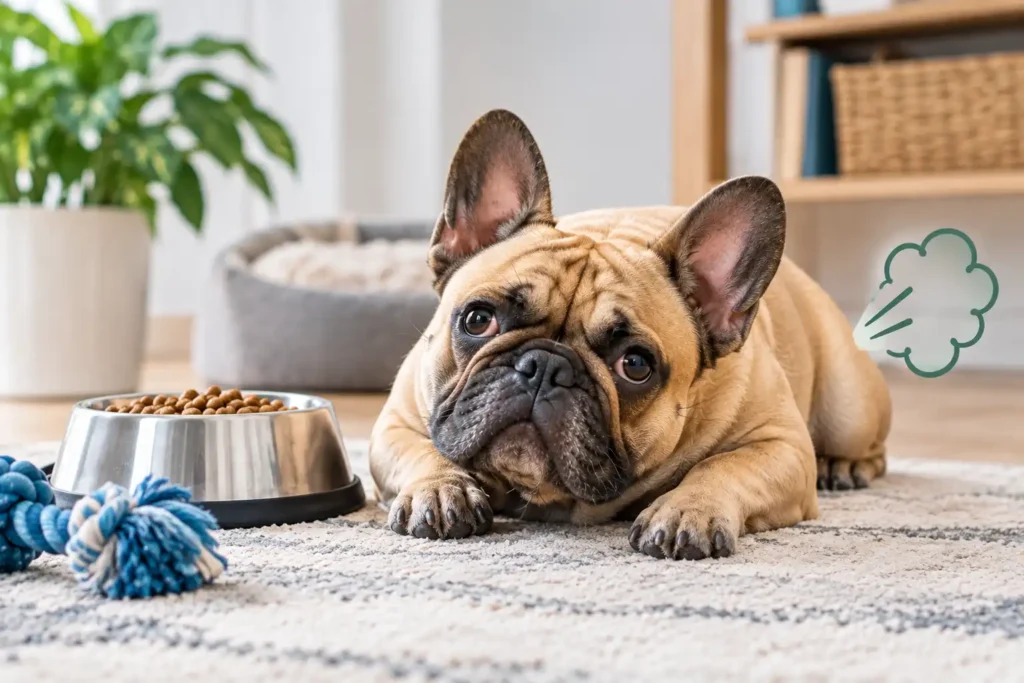
Table of Contents
Why Do French Bulldogs Fart So Much?
French Bulldogs can develop excessive gas for the same main reasons as other dogs: swallowing air, gas produced when gut bacteria break down food, or an underlying digestive problem.
Their short-faced anatomy may contribute to air swallowing in some individuals. Eating quickly, gulping food, or competing with another pet at mealtime can add to the problem. Meanwhile, bacteria in the large intestine produce gas while fermenting certain carbohydrates and fibers in food. The amount varies with the individual dog and its diet.
Veterinary-reviewed guidance from PetMD’s guide to dog flatulence discusses these mechanisms, including swallowed air, diet-related causes, and digestive disease.
A Frenchie that farts frequently does not automatically have a food intolerance or a serious health problem. What matters is whether the gas is persistent, has changed noticeably, or comes with other symptoms.
Do French Bulldogs Really Fart More Than Other Breeds?
French Bulldogs have a reputation for being particularly gassy, but the research needs a closer look before we can say how much of that reputation is supported by evidence.
A 2018 study published in the Journal of Small Animal Practice examined 98 dogs referred for brachycephalic airway syndrome, including 43 French Bulldogs. Gastrointestinal signs were common in this selected group, but the researchers assessed signs such as drooling, regurgitation, and vomiting—not how frequently the dogs farted. Read the study on PubMed.
A 2025 study examined gastrointestinal findings in 176 French Bulldogs with brachycephalic airway obstructive syndrome. It found gastrointestinal abnormalities to be common among these clinically affected dogs, but the study was not designed to measure flatulence in the general French Bulldog population. Read the 2025 study.
These findings support the importance of digestive health in French Bulldogs with airway problems. They do not establish that every Frenchie farts more than dogs of other breeds.
For an individual owner, observing changes in eating habits, diet, stool, and general health is more useful than assuming that every episode of gas is simply part of being a Frenchie.
What Could Be Triggering Your Frenchie’s Gas?
Rather than immediately changing your dog’s food, start by looking at when the gas occurs and what else has changed. These patterns can offer clues, although they cannot confirm a diagnosis by themselves.
| What You Notice | What It May Suggest | What to Check |
|---|---|---|
| Gas around mealtimes when your dog eats rapidly | Swallowed air may contribute | Eating speed and competition with other pets |
| Gas begins after a new food, treat, or chew | A recent dietary change may be involved | What changed and when |
| Gas repeatedly follows rich table scraps or particular treats | The food or portion may not agree with your dog | Ingredients, quantity, and timing |
| Gas occurs with persistent loose stools or diarrhea | A digestive problem may need investigation | Stool changes, appetite, and other symptoms |
| Gas becomes more frequent without an obvious food change | Several causes are possible | Whether the change persists and whether other symptoms appear |
One episode after a new treat does not prove that the treat caused the problem. Look for a pattern rather than blaming an ingredient based on a single occurrence.
If you suspect a particular food, keep the investigation specific. For example, our Can Frenchies Eat Cheese? guide covers the considerations around cheese rather than repeating food-by-food safety advice here.
A Simple Seven-Day French Bulldog Gas Tracker
When gas happens repeatedly, it can be difficult to remember what your dog ate or when symptoms appeared. For seven days, keep a brief record of meals, treats, eating habits, gas, and any other symptoms. You can use a phone note or notebook, using the guide below.
| What to Track | What to Record |
|---|---|
| Food, treats and chews | Record what your Frenchie ate, approximate amounts, and when each item was given. |
| Eating habits | Note whether your dog ate slowly, gulped food, or competed with another pet at mealtime. |
| Gas pattern | Record when gas occurred, how frequently it happened, and whether it followed a meal. |
| Stool changes | Note whether stools appeared normal or whether you noticed looseness, diarrhea, or another change. |
| Other symptoms | Record changes in appetite, vomiting, abdominal discomfort, or energy levels. |
| Recent changes | Note new foods, supplements, medicines, or changes in your dog’s routine. |
Example of a useful note: “Evening meal: usual food and a new chew; ate quickly; gas appeared later; stool looked normal.” Record what happened rather than assuming which item caused it. If concerning symptoms develop, contact your veterinarian instead of waiting for the tracking period to end.
How Can You Reduce French Bulldog Gas Safely?
The best first step depends on what your observations suggest. You do not need to buy several new products or change your dog’s entire diet at once.
Slow Down a Fast Eater
If your Frenchie regularly gulps food, try a suitably sized slow-feeder bowl or food puzzle that encourages more controlled eating. If other pets compete for food, feeding them separately may help reduce rushing at mealtimes.
These measures may help dogs that swallow excess air while eating. They will not necessarily resolve gas caused by food fermentation or an underlying medical problem.
Keep Meals and Treats Consistent
Measure your dog’s regular food according to its feeding plan and keep track of extras. Frequent table scraps, rich treats, or several new chews can make it harder to identify what is affecting digestion.
You do not need to remove every ingredient commonly associated with gas. The goal is to find out what suits your individual dog, not to assume that a particular grain, protein, or fiber is unsuitable for all Frenchies.
Make Food Changes Gradually
If a diet change is appropriate, transition according to your veterinarian’s advice and the food manufacturer’s guidance. Switching between several foods within a short period can make the cause of a digestive reaction harder to identify.
If the gas continues despite a consistent routine, a veterinarian may recommend a more structured dietary trial or additional investigation.
Be Careful With Supplements
Probiotics and other digestive supplements are not guaranteed solutions for flatulence. Their usefulness depends on the dog’s circumstances and the product involved. Ask your veterinarian before introducing one, particularly if your Frenchie has persistent digestive symptoms or takes medication.
Does Gas Alone Mean a French Bulldog Has a Food Allergy?
No. Gas by itself does not establish that a dog has a food allergy.
Food-related digestive reactions can have several explanations, and allergies are only one possibility. If gas appears alongside recurring itching, ear problems, or skin irritation, discuss the combination with your veterinarian instead of trying to identify an allergy through repeated food changes.
Our French Bulldog Allergies guide covers that separate issue in more detail.
When Should You Contact a Vet About French Bulldog Gas?
Occasional gas in an otherwise comfortable dog is usually less concerning than a persistent change. Arrange a veterinary appointment if the flatulence keeps recurring, becomes noticeably worse, or appears alongside:
- Repeated vomiting or diarrhea
- Loss of appetite
- Unexplained weight loss
- Ongoing abdominal discomfort
- Changes in stool that do not resolve
- Other changes in energy or general behavior
A veterinarian can assess your dog’s history, diet, physical condition, and other signs to decide whether testing or a supervised diet change is needed. Do not assume that unusually strong-smelling gas identifies a particular disease.
Know the emergency signs, too. A suddenly swollen or painful abdomen accompanied by repeated unsuccessful attempts to vomit, marked restlessness, excessive drooling, weakness, or collapse can indicate gastric dilatation-volvulus (GDV), a life-threatening emergency. Seek emergency veterinary care immediately rather than treating it as ordinary gas. The Merck Veterinary Manual explains the warning signs of bloat.
French Bulldog Gas FAQs
Are probiotics proven to stop French Bulldog gas?
No single probiotic is guaranteed to stop flatulence in every Frenchie. Whether a supplement is appropriate depends on the dog’s symptoms and underlying cause, so ask your veterinarian before starting one.
Can I give my French Bulldog human gas medicine?
Do not give human medication without veterinary guidance. Whether a product is appropriate depends on its ingredients, dose, your dog’s health, and the symptoms being treated.
Should I change my French Bulldog’s protein source if the gas continues?
Not automatically. A protein change may be useful in certain cases, but repeated unsupervised diet changes can make it harder to identify the cause. If gas persists, ask your veterinarian whether a structured dietary trial is appropriate.
Medical Disclaimer
This article is for general educational purposes only and is not a substitute for veterinary diagnosis or treatment. Persistent digestive symptoms or sudden changes in your French Bulldog’s condition should be assessed by a veterinarian. Seek emergency care for a swollen abdomen accompanied by repeated unsuccessful retching, severe distress, weakness, or collapse.
Sources Consulted
- PetMD — Why Your Dog Farts and What to Do About It — veterinary-reviewed overview of flatulence, dietary factors, swallowed air, and digestive conditions.
- Kaye et al., 2018 — Relationship Between Brachycephalic Airway Syndrome and Gastrointestinal Signs in Three Breeds of Dog — clinical research on gastrointestinal signs in dogs with brachycephalic airway syndrome.
- Clinical Evaluation of Gastrointestinal Findings in 176 French Bulldogs With Brachycephalic Airway Obstructive Syndrome, 2025 — study of gastrointestinal findings in a selected clinical population of French Bulldogs.
- American Kennel Club — Excessive Gas in Dogs — practical guidance on feeding habits, diet, and flatulence.
- Merck Veterinary Manual — Disorders of the Stomach and Intestines in Dogs — information on digestive disorders and the emergency signs of bloat.